• Skip to main content
  • Skip to primary sidebar

Cat Info

Common Sense. Healthy Cats.

Search Results for: scented or unscented litter

The Litter Box From Your Cat’s Point of View

Lisa A. Pierson, DVM

pdf-icon-dark  French translation

May 2025 – This page was written many years ago but the information is as relevant today as when it was written.

~~~~~~~~~~~~~~~~~

Urinating and defecating outside of the litter box, also known as “inappropriate elimination,” is one of the most common reasons for a cat to be relinquished to a shelter or, in some cases, abused.  Sadly, in most cases it is the fault of the human in charge of the litter box duties making this an ‘appropriate elimination’ issue because who would want to walk in their own urine and feces?

The “fault” usually involves a dirty box or one that is too small and it is perfectly appropriate for a cat to seek out a cleaner place to do his or her elimination.  Wouldn’t you consider doing the same thing if you were not offered a clean bathroom?

Punishing these cats is not only inhumane but is ineffective and will often make things worse.

When someone is asked how often they flush their toilet,  the answer is usually, “every time it is used, of course!”   We all know how repulsive ‘porta-potties’ are and we are not even asked to walk around in our own waste like humans often ask of their cats!

So why do we expect our cats to use dirty litter boxes instead of just going some place else?

Humans seem to forget that a cat’s sense of smell is infinitely more sensitive than our own.  Add to this the instinctive nature of the cat to be clean and it is easy to see how a dirty litter box often spells disaster.

Think about how a wild cat would handle his bathroom duties.  He would not be confined to a 1’ x 2’ bathroom. He would not choose to walk around in his own waste.  He would simply choose another plot of land and that “plot of land” could be behind your sofa or in another area of your home.

Please click on the links below to read more about the key issues concerning litter boxes.

You will notice that many key statements are repeated several times on this webpage.  This is because many people may read only isolated sections.

Top reasons for a cat to stop using the litter box

Do’s and Don’t’s

Gimmicks – Products that promote laziness

Types of litter

In search of the best cat litter

Types of litter boxes, size, number, location

Kittens/new adult arrivals and litter box usage

Cleaning the litter box – method to save time and money (video)

Litter mats

Children and litter boxes

***Inappropriate elimination***

***I frequently receive requests for help from people who have a cat that is not using the litter box.  They often state that they have “tried everything” but most of these desperate people have not thoroughly read this webpage and implemented all the suggestions – including the use of Dr. Elsey’s Cat Attract  which is discussed/linked to at the bottom of this page.

Please do not consider yourself having “tried everything” until you have tried Dr. Elsey’s Cat Attract as discussed below.  Will it solve all elimination problems?  No, it won’t but it has helped bring many cats back to the litter box so it is always worth a try.

If you need more help past what is on this extensive webpage, I am available for phone consultations.  No advice can be given via email otherwise I would have to type my fingers to bloody stubs.  There are a lot of variables to consider when dealing with this problem.

Top reasons for a cat to stop using the litter box:

  • Dirty litter box(es)
  • Poor choice of litter form (using pellets/crystals/non-clumping litter which are uncomfortable to walk on and do not allow for complete urine removal)
  • Poor location of litter box(es)
  • Blocked from the box by a dominant feline housemate
  • Unable to relax and get to the box, or use it, due to fear of a strange human, dog, active child, loud noise, etc., in the house environment
  • Box size is too small
  • Too few boxes
  • Medical problem(s) – This should always be a serious consideration.

Many medical issues such as diabetes, cystitis (painful bladder inflammation), bladder stones, and a partial urethral blockage (always an emergency!) can cause a cat to stop using his litter box.  Please see Feline Urinary Tract Health for more information.

Please also note that most urinary tract problems can be avoided by feeding canned food – not dry food. The increased water content and the decreased carbohydrate content of canned food are healthier for your cat than dry food.  Please see my Feeding Your Cat and Feline Diabetes articles on this site.

Do:

  • Scoop the litter box twice daily – at a minimum.
  • Use clumping litter – except for kittens younger than 6 – 7 weeks of age.
  • Use unscented litter.
  • Keep the litter deep enough.
  • Use large litter boxes.
  • Have enough litter boxes available.
  • Have litter boxes placed in a quiet area.
  • Use a litter mat that is comfortable for your cat to walk on.
  • Seek veterinary attention if your cat stops using the litter box.

Do NOT:

  • Use litters that do not clump – except for kittens younger than 6 – 7 weeks of age.
  • Use pelleted (pine or newspaper) or crystal/white pearl litters.
  • Use scented litters or any deodorizers.
  • Use hooded litter boxes if your intent is to prevent odors from reaching your nose.
  • Use plastic ‘grass’ mats.
  • Punish your cat for not using the litter box.
  • Put a child in charge of litter box maintenance.

Scoop litter boxes at least twice daily removing both feces and urine. 

It is critical to be able to remove both the feces and the urine each time the box is cleaned.  Clumping litter is the only type of litter that allows for this to be done completely.  Complete removal of the urine is not possible with the non-clumping clay litters, the white pearl litters and any type of pelleted litters such as newspaper or pine.

Remember, even a small amount of urine smells strong to a cat!  With non-clumping litters, only the feces are removed and some, but not all, of the urine, thus only ‘flushing’ half of the cat’s toilet.

EXCEPTION TO ABOVE:  Kittens (younger than 6 – 7 weeks of age) often have temporary bouts of diarrhea for various reasons.  They are also more apt to step in their feces and then end up with messy cement boots.  Very small kittens may even attempt to eat the litter.

For this reason, I advise using a NONclumping litter for small kittens.  This is the only time I will use a pelleted litter (I prefer newspaper pellets over the pine pellets) or the non-clumping clay litter – always UNscented.  To maintain strict cleanliness, discard the entire amount of litter as necessary (2-3 times daily) and wash the litter box before re-filling.  Do NOT just simply remove the feces – the urine MUST be discarded also.

Gimmicks

It seems as if more and more products are coming out on the market to allow humans to avoid maintaining a litter box properly.

Here is an example of a product that a lazy human may try to use to avoid keeping a litter box clean.  Littervent is a venting system to remove foul odors from a litter box but what is wrong with this picture (product)?  If there is enough waste material in your cat’s litter box to generate a foul odor – enough to necessitate setting up an exhaust system to remove the air from the box – just what are you expecting your cat to walk through?!

‘Together’ is another example of a product that is, once again, catering to a person who is not taking the time to keep their cat’s litter box clean and/or who is not using a clumping litter that allows for removal of all of the urine.  This product claims to be “eco-friendly because it eliminates the formation of ammonia gases” and to “help dry all waste material faster.”

Now why would we want to “dry” the waste matter when *removing* it makes so much more sense?  No matter if it is dry or not, your cat will still have to walk through it until it is removed and it will still smell like urine and feces!

Please do not use products like these in lieu of keeping the litter box clean.

Keep in mind how much better your cat’s sense of smell is when compared to yours.  They have incredibly keen noses and just because your nose cannot detect an odor, this does not mean that your cat’s nose cannot smell the waste products.

PLEASE……just clean the litter box and do not try to use gimmicks that promote doing  otherwise.

Types of Litter

First of all, there is no perfect litter.  I think that I would give my right arm if there was but they all have their drawbacks.  Some of the problems associated with the various types of litters are inconveniences for the human and some are strong negatives from the cat’s point of view.  Given how common inappropriate (appropriate??) elimination (IE) problems are, I will always choose the litter that will be the most inviting to my cats.

I spend a great deal of my behavioral-consulting time dealing with the nightmare of IE. ‘Inappropriate elimination’ is a fancy term for a cat that is urinating and/or defecating outside of the litter box.  Given the fact that *most* of these problems are man-made (illogical litters like pellets being used, dirty litter boxes, non-clumping litters, small or enclosed boxes that are scary or stinky, etc.), I do whatever I can to provide my cats with the most natural and inviting litter available and that happens to be an UNscented clumping litter.

***Note that I said that “most” of these problems are man-made but I want to reiterate – if your cat suddenly stops using the litter box, please consult with your veterinarian immediately.  There are plenty of medical reasons for a cat to stop using his or her box – some can be life-threatening – so please start with a veterinary exam.

Do I get frustrated with the negatives of clumping litter?  You bet that I do!  I get very tired of stepping on it and seeing the dust on my furniture.  I would rather not have a Swiffer Max in my hands so often.  I keep thinking that there *must* be a better system but, in the end, I always stick with what I have written on this webpage.

I will continue to complain when doing housework but I will keep in mind how much worse it would be if my cats went on strike – urinating and defecating elsewhere – all because I tried to force them to use a litter and litter box system that was not to their liking.  I love my cats and a bit of housework is simply the price that I have to pay to give them a very inviting litter box set-up.  Now that I have voiced my very strong opinion that a clumping litter is the only sanitary way to maintain a litter box, what are the options in the clumping litter department?

Clumping litter comes in several forms

– (examples in parentheses):

  1. clay (Dr. Elsey’s Precious Cat Ultra, or the loose litter in the big bin at Pet Co)
  2. corn (World’s Best Cat Litter)
  3. wheat (SweatScoop)
  4. pine (Feline Pine – not the pellets but the clumping version)
  5. grass (SmartCat by Pioneer Pet)

For the past 20 years, I have used Dr. Elsey’s which is a clumping clay litter but I recently tried SmartCat, a clumping litter made out of grass and have decided to switch from Dr. Elsey’s to SmartCat.

Comparison of Dr. Elsey’s clumping clay with SmartCat clumping grass:

  • SmartCat is lighter than Dr. Elsey’s and I am getting too old to carry 40 lbs of litter.  I would rather carry the 20 lbs bags of SmartCat.
  • They both track equally so no improvement there.
  • They both clump well.
  • Odor control – I don’t pay attention to this because to control odor, CLEAN THE DARN BOX!  Do not look to litter as a way of controlling odor. That said, both are equal in odor control.  A clay urine ball does not smell any different than a grass urine ball.
  • SmartCat is slightly less dusty than some batches of Dr. Elsey’s and more dusty than other batches.  Do not believe any company’s claim that their litter is “99% dust free.”  99% of what?  Believe me, they are all dusty.

Note that the dust situation is not just important from a house cleaning standpoint.  It is also important in terms of causing an allergic response in whatever living being is breathing it in.  We know that corn and wheat litters are more hyperallergenic than clay which is relatively inert.

(We see more feline asthma with the corn and wheat litters when compared to the clay litters.)

As discussed elsewhere on this page, I do not favor the use of covered boxes – no matter what litter is being used – because they force the cat to inhale more dust.

If you do try any plant-based litter, monitor your cat for any signs of respiratory problems (coughing or increased respiration rate or effort).

Note:  I found World’s Best Cat Litter to be much dustier than SmartCat.

  • SmartCat is ‘renewable’ so it is more ecologically-friendly.
  • SmartCat is biodegradable.
  • One area where a heavier litter like clay wins out is that it is more firm to walk on.  A couple of my cats had serious reservations about walking in 3″ of SmartCat because it gave way easily and they sunk down pretty far.  However, even at this relatively shallow depth (compared to how I have always kept the Dr. Elsey’s at 3.5-4″) the urine reached the bottom of the box.

I have always been a stickler for keeping the litter box full enough to not let the urine reach the bottom but that is a little more difficult to accomplish with SmartCat due to its light density.  The point of clumping litter is to allow for the urine to clump *before* it reaches the bottom of the box.

When that happens, the bottom of the box does not come in contact with the urine (plastic is porous and will absorb urine odor) and you won’t have to be scraping urine clumps off the bottom of the box which can break up leading to contamination of the litter with small pieces.

With a very light litter like SmartCat, the urine percolates down to the bottom of the box rather quickly.  If I keep the litter 4″ deep, the urine is less likely to reach the bottom which I definitely want to avoid.  But, it is a catch-22 in that some cats will not be happy about walking in deep litter that gives way.

Fortunately, all but one of my cats have gotten used to ‘wading through’ deep litter and it does not seem to bother them now but some cats may not like SmartCat and would prefer a firm clay litter.

If you decide to switch litters, do not remove your old litter until you are sure that your cat has accepted the change.

If SmartCat does not work out for you or your cat, all of the members of our rescue group have been very satisfied with Dr. Elsey’s Precious Cat Ultra clumping litter for the past ~20 years.  (I have been told by a company representative that the Classic version is pretty much the same as their Ultra product.  Also, see below for information on Dr. Elsey’s Cat Attract products for inappropriate elimination problems.)

litter-flash-brighter-smudged-flash-web

Please be aware that all litters vary from batch-to-batch in terms of dust levels. Sometimes I get a great bag of Dr. Elsey’s with very little dust and sometimes I get a bag that contains more dust.  This is the nature of a natural product.  It will vary.

Another litter that I have used on occasion is the clumping clay litter that can be found in the free-standing bins at Pet Co.  I think that it used to be called “Pet Gold” but I am not sure what it is called now.

I have found this Pet Co litter to be fairly  low in dust and it clumps very well.  You need to purchase an original container of the product and then return with that empty container for (cheaper) re-fills.

In July 2012, I had the opportunity to try a litter called Boxiecat.  This litter is completely UNscented and is very low in dust – comparable to Dr. Elsey’s.  However, it did not clump as well as Dr. Elsey’s which is a significant issue for me.  Dr. Elsey’s clumps so strongly resulting in the removal of every speck of waste, whereas Boxiecat litter breaks up a bit.

You will note under the “Cleaning” section below that I never completely empty my litter boxes.  I simply add to the boxes to maintain a 3.5″ – 4″ depth.  Therefore, it is imperative that I use a litter that forms strong clumps.

Boxiecat litter is available only as a home-delivery product making it a very expensive choice due to shipping costs.  That said, if cost is not an issue for you and you prefer the convenience of not having to schlep heavy litter home from the store, Boxiecat is a very good choice.  I love the fact that it is completely unscented and low in dust.

Prior to our rescue group’s discovery of Dr. Elsey’s litter, we had good luck with 3 litters made by the Clorox company but a few years ago, their “unscented” litters were anything but unscented!

Their EverClean, EverFresh, and ScoopAway litters started carrying a heavy perfume smell despite the word “unscented” printed on the containers.  Added perfume is simply a way for lazy people to not clean the litter box frequently and I refuse to use any litter with perfume.

Always use unscented litters and do not add any deodorizers to the litter or around the litter box.  Cats, because of their extremely keen sense of smell, are often put off by scented litters and perfumed environments.  In addition, they do not need to be grooming perfume chemicals from their coat.  There is absolutely NO need for special perfumes or additives if a cat box is maintained correctly. The best way to keep the box odor free is to clean it!   Odors should be removed, not attempts made to cover them up.  

Also, I highly recommend not using plastic liners. Liners are very annoying to the cat when they get their claws stuck in them and do not work with the best system to use for clumping litter as outlined below in the Cleaning section.

Always In Search of the Best Cat Litter

In 2007 I decided to give  World’s Best Cat Litter (WBCL) Extra Strength another try even though I do worry about the hyperallergenic nature of corn dust.  I had tried this corn-based product several years prior and found it to be quite dusty.  I had it in a room with dark paneling and it was not too long  before I could write my name on the walls.  It was no better than the Dr. Elsey’s litter in terms of dust and there was also NO improvement with regard to the tracking issue.  In fact, I found it to be a bit worse in the tracking department.

But….I decided to give WBCL one more try.

I took a bucket of Dr. Elsey’s Ultra litter (the very-dusty product that was coming from the company at that time) and a bucket of WBCL out into my yard.  I took handfuls of both and let the litter run from my hands about a foot above the bucket.  They were about equal in the dust department.

When I compared WBCL to Dr. Elsey’s Precious cat (non-Ultra), I found WBCL to be dustier.

Here is where they do differ:  I attended a seminar on feline respiratory diseases a couple of years ago.  The speaker noted that they see more asthma in cats on corn and wheat-based litters than they do on the more inert clay litters.  I did not find this surprising given that corn and wheat are hyperallergens.  For this reason, I am very reluctant to use WBCL.

WBCL makes this claim on their webpage which I strongly disagree with:

“With WORLD’S BEST CAT LITTER™ there is no need to worry about a cat or its owner inhaling problematic dust.”

I don’t see how they can make the claim that breathing in corn (or wheat in the case of SweatScoop) dust is not “problematic.”

I recently had to cage one of my new foster cats for 2 days.  I used WBCL in her very large cage.  This is the amount of dust and litter that she tracked into her bed in just 48 hours.  When I shook her bed out, there was a considerable amount of dust in the air.  I just do not see how anybody can refer to this litter as “low in dust and tracking.”

wbcl-dust-pan-copy

All of the above said, I really do not have a huge problem with people using WBCL.  At least it is a clumping litter.  However, if a cat has asthma, this is not a litter that I would be using and, given the dust issue, I would not be using it in any hooded litter boxes.  It is bad enough that they are going to breathe in the corn dust even when digging in an uncovered box but a covered box will increase the amount of corn dust that will end up in their lungs.  Of course, the same can be said for clay litter dust and covered boxes.

WBCL has a strong corn smell that puts some cats off or confuses them.  I have consulted with clients who have switched to WBCL or SweatScoop only to have their cats refuse to use the litter box.  Some cats may not view corn or wheat as litter and some cats will even eat it.  This latter problem is not surprising since many cats are being fed a terribly species-inappropriate diet of corn- and wheat-laden dry foods.  Please see Feeding Your Cat – Know the Basics of Feline Nutrition for reasons why you are not doing your cat any favors if you are feeding any dry food.

I once bought some Feline Pine Scoopable litter but I did not even put this in a litter box.  The minute I opened the bag I decided that this litter would never be used for my cats.  The pine smell was terribly strong and it was very dusty.  People talk about how wonderful that pine smell is but *my* nose is not what is important here.  Considering how sensitive a cat’s nose is, I do not recommend this litter.

Several years ago I tried SweatScoop and was not satisfied with the clumping ability or the dust levels of this litter.  Others have commented on the fact that once it is stuck to the litter pan, it is like trying to remove hardened cement.  This is also a litter that I cannot recommend.

Types of Litter Boxes, Size, Number, and Location

Size:

The size of the litter box is very important.  It is very common for people to pick out a litter box that is too small which can result in the cat stepping in his own waste.  This can result in a litter box aversion causing the cat to urinate and defecate elsewhere.

The bigger the box, the more inviting it will be to your cat.  The more inviting the litter box is to the cat, the more apt he will be to use it instead of soiling your home. 

Keep in mind that conventional litter boxes are not your only options.  Storage containers often make much better choices since they are larger and often less expensive.

If you go to this Sterilite website, look at the 30 gallon Basic Tote (my preference) or the 18 gallon Basic Tote.  Always look for a storage container with the smoothest inside.

I need a very tall (17″ – 19″) box because a couple of my cats stand up to pee.  They are what I not-so-affectionately refer to as “elevator butt pee’ers.”

I keep my litter 3.5 – 4 inches deep so I need another ~14 inches of height to keep the urine contained in the box.

Here is a picture of the Sterilite storage container (litter box) that I use in my home ($15 from Target):

litter-box-on-deck

The internal dimensions of the container are 19.5″ wide x 29.5″ long x 19″ high.  My cats LOVE their roomy bathroom!

Of course, you do not have to use bins this big but this size works for my home and my cats and actually takes up less room than the two covered boxes that I used to have side-by-side.  Pick the size that works for you keeping in mind that the bigger the bathroom, the more inviting it will be for your cat.

If your cat does not stand up to urinate, then sweater boxes work well for litter boxes  The one linked here is 12″ tall so I would suggest cutting a section in the side of the box so that the cat can comfortably step into it.  This will be especially important for an older cat that may not be comfortable jumping in and out of it.  I would cut the door in the long side and not the short side (the end)….hoping that this would entice the cat to turn left or right to get his body parallel with the long axis of the box and not urinate out the door.

The storage bins that  I use would not exactly make it into ‘Better Homes & Gardens’ but I love my cats and I will do anything to make them love their litter box.  I am deathly afraid of any inappropriate elimination issues and my cats have always been perfect with their litter boxes and I want to keep it that way.

To me, this less-than-aesthetically-pleasing litter box is a very small price to pay for a home that does not smell like cat urine.

If you have a cat that stands up to urinate or have one that really likes to dig to China and fling litter around, I urge you to consider a deep storage container that is at least 17″ wide and 22″ long and 17″ – 19″ deep.  The height will be determined by you and your cat – depending on how high his or her rear end goes when they urinate.  I need my boxes to be 19″ high but you may get away with using one that is 17″ high.

The depth of the litter is maintained at 3.5″ – 4″.  ~68 pounds of clumping clay litter ends up giving a 3.5″ depth.  ~80 pounds of litter gives a 4″ depth.  Obviously you will not be dumping this litter on a regular basis so you must be careful how you clean the box.

The bottom of the door is 8″ from the floor.  The door is 9″ x 9″ and I used a utility knife (aka “box cutter”) to cut the door.  It was very easy to do.  I just drew my lines and then scored the lines with the utility knife several times and it cut right through it.  If you get a clear plastic box, however, the material is brittle and may crack so be careful.

Definitely cut a door in the box and don’t ask your cats to jump in and out of it.  Jumping into it is easy for young cats but pushing off of sand that gives way is not going to be a good thing for the joints in their hind legs or their back – no matter the age of the cat.   An older, arthritic cat would probably end up refusing to use the box if forced to jump in and out of it.

Note regarding door placement:  I have had reports that some cats will walk into their litter boxes and then urinate out the door.  If you put the door on the *end* of the long side, versus in the middle like I did, then your cat will be more apt to go into the box and make a 90 degree turn and….hopefully….not urinate out the door.

Or….you can put the door on the end (short side) of the box and hope that your cat walks into the box far enough from the door to not urinate out the door.  (The Kat Kave shown below has the door on the end of the box versus on the long side like my box.)

Here is a picture of a light that I recently added to the box:

light-for-lb-text

The light is a $10 ‘under cabinet’ light from Home Depot that takes 8 AA batteries.  In the interest of staying ‘green,’ I use rechargeable batteries but regular alkaline batteries are fine and will probably last a couple of years considering that the light will only be used for a few minutes each day for scooping the box.

The only negative about these boxes is that I can’t use my cleaning method shown in the movie below so I have to be careful as I scoop so as not to break up any urine or fecal balls.  I am very fastidious about the cleanliness of the boxes and breaking up the urine balls would not make for a very clean litter box.

Other than not being able to tip the box as shown in the video, I clean the box in the same manner – being careful to always clean any urine or fecal residue from the sides of the box.  I do this at each scooping versus letting it build up and then scrubbing the box once a week.

If you have an elevator butt pee’er and cannot find a suitable storage container in a store near you, the Kat Kave is a great (albeit, more expensive) option.

The Kat Kave is a bit smaller (without the lid = L 27.75″ x W 18.5″ x H 17.5″) than my storage container but has plenty of room even for the largest cat.

andy-kattails2web

Personally, I would not use the lid that comes with the Kat Kave for 3 reasons:

1) I clean my litter boxes 2-3 times each day and it would drive me nuts to have to remove the lid each time.

2) I am not a fan of covered boxes due to the fact that there is less ventilation and light.

3) People tend to not clean them as often due to the ‘out of sight; out of mind’ issue.

I realize that the Kat Kave is a bit on the pricey side but I really like the size of it and, if properly cleaned and maintained as I discuss below, litter boxes can last for a very long time so I consider it to be a very good investment.

The Kat Kave discusses having a smooth floor but as noted many times on this webpage, you should be keeping the litter deep enough so that no urine balls get stuck to the bottom – making a smooth floor a non-issue.

Covered vs Uncovered:

Covered Litter Box
Covered Litter Box
Uncovered Litter Box

As mentioned above, I strongly prefer UNcovered litter boxes.

Update December, 2007:

The covered box shown above is no longer being made. It was Petmate’s old ‘Jumbo’ – internal dimensions = 20.5″L x 15″W x 19″H.  Petmate changed the design of the box and the new version of the Jumbo is not as big as the old one.  (Despite the measurements they give on their website, the new pan is not as large as the old pan.)

I used the Petmate covered box shown above for many years but then got tired of seeing my cats scrunched up in it  – especially as they were getting older and possibly arthritic.  Also, the fact that the litter dust is contained in these covered boxes – adding more insult to their lungs – started to bother me more.

If you really want to use a covered litter box, I urge you to consider purchasing the Kat Kave due to its nice, roomy size.  You will have the option to leave the lid on or take it off and it has the convenience of already having a door cut in it.

Of course, you can also use a storage container with its lid if you want a cheap, large, covered litter box.

The decision to use a covered versus uncovered litter box involves issues from both the human’s and the cat’s perspective.  I would encourage you to always consider your cat’s wishes first and foremost since if a cat is not pleased with his bathroom accommodations, the human will usually suffer for it in the form of a ruined house from cat urine/feces.

Covered boxes – negative issues:

When comparing covered and uncovered boxes of equal size, a covered litter box takes up the same amount of floor space that an uncovered box does but is effectively much smaller for your cat since his head cannot extend beyond the perimeter of the pan.

Some cats become very claustrophobic in covered boxes which causes a sense of feeling trapped – especially if there are ‘bully’ feline housemates waiting to pounce on the cat after he leaves the litter box.  Often the scratching in the litter box will entice the other cats in the house to come over to see what the noise is.  Then…the poor cat in the box may not feel comfortable exiting the litter box because the other cats are too close.  Soon, the more timid cat will start doing his business elsewhere.

Covered boxes are also just too small for most cats – forcing them to contort their body to urinate/defecate and dig/bury without stepping in their waste.  Often they do not succeed in missing their waste (especially as they get older or have medical problems such as diabetes or kidney disease) and end up stepping in it which results in them tracking urine/feces around your house and upsetting the cat.  And remember – if your cat is upset with his litter box experience, he may just decide to go elsewhere.

I especially dislike the Booda Clean Step box because the actual size of the usable space for the cat to ‘do his business in’ is very, very small.

Covered litter boxes can also present a problem of ‘out of sight; out of mind’ in that some people are less apt to scoop the litter box frequently enough when the box is covered.

Some people have actually commented that they like covered litter boxes because there is “less odor!”  This is very dangerous thinking, not to mention inconsiderate for the cat’s comfort.   Covered boxes will trap odors which can lead to the cat’s refusal to use it.

If you are using a covered litter box to minimize odor for yourself, you must re-evaluate your thinking and consider the fact that your cat’s sense of smell is MUCH more sensitive than yours.

Stick your head inside the box and take a deep breath.  If you are unwilling to do this, why would your cat want to use the box?  And even if it smells ok to you, that does not mean that it smells clean to your cat.

Dust is also trapped in covered boxes instead of being dissipated a bit more as it will be in an uncovered box.  This can be very hard on your cat’s lungs.  Of course, cats do breathe in dust in any type of box since their noses are very close to the litter as they are digging but the problem is accentuated in a covered box.

I highly suggest that you remove any filter from the top of a commercially made covered litter box for better ventilation of odors and dust.  Filters are useless gimmicks that the manufacturers claim “trap odors.”  Odors should be removed – not “trapped.”

Some covered boxes are not well-constructed with respect to how the lid fits on the box.  This can result in urine leaking out between the box and the cover and onto the floor if the cat stands up to urinate.  This also leads to urine collecting in the seam which causes a lingering urine odor.

This will never be a problem with a tall storage container or the Kat Kave.

Covered boxes – positive issues:

Covered boxes offer privacy to a timid cat but you will have to watch him carefully to make sure that he is not being stalked by other cats in the household.  Otherwise, he may start to feel trapped.

Covered boxes are neater – keeping the litter inside the box and also the urine if your cat tends to stand up to urinate.  However, a tall-sided storage container – with or without the lid – works better for these issues since there is no seam for urine to gather between the lid and box.

As I outline below in the Cleaning the Litter Box section,  you are defeating the purpose of clumping litter if you keep the litter shallow enough for the urine to reach the bottom.  So, to prevent this problem, you need to have your litter at least 3.5″ deep and if your cat digs to China, you may need 4″ like I keep in my boxes.  A covered box does contain the litter better than a shallow, uncovered box.

Uncovered boxes:

Petmate’s Giant Litter Pan is a good choice for a large, uncovered litter box.

The Biddy Box shown below has the right idea in terms of size but I do not like the design.  The sloping ends make the litter very shallow in that area.  Because of this, the urine balls get stuck to the bottom of the litter box.  See the Cleaning section below for why this defeats the purpose of clumping litter.  (The litter should always be deep enough so as to prevent urine balls from sticking to the bottom of the box.)

The same problem can occur with cement mixing containers which are cheap options for large litter boxes.

biddy-box-2-copy

Please note that I strongly disagree with the dialog in the movie that you can view on Biddy Cat’s website.  In fact, this is a great example of how not to maintain a litter box as it pertains to litter depth.  The movie discusses “scraping the waste off of the bottom of the litter box.”

Again, if you allow the litter to get so shallow that the urine and feces stick to the bottom, you will be defeating the purpose of clumping litter which is to remove the waste in total.

Miscellaneous litter boxes:

I strongly dislike the Clevercat Top Entry litter box – please do not use this product.  This box is an example of humans inventing a product that is very clearly not made with the cat’s best interest in mind.

This box has a hole in the top of it and the cat has to jump down into the box. This box is too small and too confining especially for an older cat and because they have to jump up at an acute angle and push off of a surface that gives way,  it is very hard on their joints, tendons and ligaments.

I also wonder what happens when one cat in the household does not bury his waste and now the housemate has to jump down through this hole and try to miss any uncovered urine or feces.  Please do not use this litter box.  There are much better options for your cat.

Number of Boxes and Location:

The number and location of the litter boxes are very important issues.  Many cats will not use a litter box if it has been used by another cat.  In addition, some cats prefer to urinate in one box and defecate in another.  Also, a common cause of inappropriate elimination stems from a more dominant cat blocking the pathway to the litter box.  The more passive/timid cat is forced to look elsewhere for a bathroom.  In this situation it is critical to have enough boxes in safe areas to minimize the potential for problems.

Don’t put all of the litter boxes in the same spot if you have a bully cat that may be blocking a timid cat from the box.  Place the boxes in quiet, low traffic areas.  The laundry room is often not a suitable place due to the noise from the washer and dryer and has led to many litter box aversion cases.  Also, it is best to not place litter boxes near the cat’s eating area.

A very common problem arises when people allow young kittens or frightened adult cats that have recently been adopted to have access to too large of an environment without enough litter boxes close by.  Often the scared cat or kitten is hiding in one part of the house while his litter box is in another part of the house.

Keep in mind that these animals are not going to suddenly become brave when their bladder gets full and venture out to look for a litter box in a strange environment.

Humans often expect far too much from a young or scared kitten or a scared adult cat!!

In the case of a recently adopted kitten or cat, keep his world small (a single room) until you know that he is using the litter box and is comfortable in his room.  Depending on the kitten or cat, this may take several days or a couple of weeks.  Only when he is comfortable in one room should you open up the door and let him venture out.  Do not carry him to another part of the house.  Instead, let him pick his own path so that he will know how to get back to his litter box.

Even if a new kitten is brave and sociable, please do not just turn this kitten loose in a large area and expect him to know or remember where his litter box is if he gets to playing at a distance from that box – or if something does scare him and he ends up hiding in a part of the house far from his litter box.

They should not be expect to remember that their bathroom is ‘down the hall…second door on the right.’  When a kitten has to go….he has to go now and they often will not hold it while they go and search for their litter box.  Please remember that human children take a long time to potty train and be thankful that kittens are much easier to train!  However,  even though kittens are much better than human babies when it comes to being litter box trained, don’t push your luck and stress the kitten by allowing him access to a large environment without his litter box very close by and easily accessible.  Otherwise, you will end up fostering very bad habits in the kitten if he gets used to urinating and defecating in areas other than his litter box.

Cleaning the Litter Box

I will repeat the question that I posed above:  How often does a human flush their own toilet?  Please keep the answer to this question in mind as it pertains to just how clean you should be keeping your cat’s litter box.

Cats should not have to dig around in their own waste – or that of their housemates – looking for a clean spot.  I am sure that people think I’m nuts for making a video about cleaning a litter box but this is the method that I have found that works the best for cleaning a litter box with clumping litter.  This method results in the waste material being removed in total without being broken up.

Note:  I purposely let the litter box get extra dirty (I actually consider it to be unacceptably filthy) for the filming of this great event.  In my opinion, a litter box is plenty dirty once there are 2-3 ‘items’ in it.

PLEASE do NOT let your litter box get as dirty as the one shown in this video!  If you cannot stick to the ‘2-3 item’ rule because of your work schedule, then please add more boxes.

The purpose of clumping litter is to be able to remove the urine balls and feces intact and completely.  This means that the litter needs to be deep enough so that you can get the scooper under the waste material so that the urine balls and feces do not stick to the bottom of the litter box.  You can’t remove the waste material intact and in total if you are scraping it off of the bottom of the box  This is a Catch-22.  People who discard their litter on a regular basis tend to not keep the litter deep enough and then the box is a mess to clean because litter is gummed up on the bottom.  This results in waste residue ending up stuck to the bottom of the box for your cat to dig around in.  This is not sanitary and it defeats the purpose of clumping litter.

In my old covered jumbo litter box like the one shown above, I used between 30-40 pounds of clumping litter to get it to a depth (3.5″ – 4″) where my cats could not reach the bottom.  In the storage container (grey 39 gallon container shown above), I keep 80 pounds of litter in the box.

If using an uncovered box, you need to strike a balance between having too much litter in the box so that you end up with beach-front property surrounding the box, and not having enough litter so that your cat’s urine or feces ends up stuck to the bottom. If your cat is an aggressive digger and is flinging litter over the edge, you will need to get a deeper litter box.

If the urine balls get stuck to the side of the box, move the litter away, remove the urine ball and then clean the area with a dilute (1:30) bleach solution and a paper towel.  (The bottle below says 1:20 which is what I use….but this strength will ruin most sprayers so stick to 1:30.)   Rather than using my scooper to scrape off the urine ball, I usually just hit the side of the box and the urine ball dislodges and falls into the scooper.  That way, I don’t have to clean the scooper when I am done.

Industrial-grade spray bottle for bleach solution

Also, clean any fecal material from the side of the box.  I prefer light colored boxes which allow me to see the soiled areas easier. Don’t forget to clean the cover if soiled.  Dry the area and move the litter back.  Keep a roll of paper towels and a dilute bleach solution in a spray bottle next to each litter box.  I find that the Spraymaster, an industrial grade spray bottle from Home Depot or Smart & Final, works the best for a bleach solution.  The cheaper spray bottles do not hold up well when used for bleach.  Also, bleach degrades when exposed to light so an opaque bottle is needed.

Many people choose to discard the litter every week or two and start fresh but their litter box and litter are often very dirty by the time they get around to dumping all of the litter and scrubbing the box.  There is a more sanitary alternative to this method as shown in the video.

My feeling is that I want my cats’ bathroom to be very clean on a daily basis.  I do not allow the box or the litter to get to the point that it needs a once-a-week or even once-every-two-weeks discard/scrubbing.

Throwing litter away on a frequent basis is expensive, time-consuming and hard on the back.  There really is an easier and cheaper way to maintain a clean litter box – but you must be thorough in your cleaning, and scoop frequently (2-3 times/day) – which your cat will appreciate. You also must use a litter that clumps very well.

For the method shown in the video, you will need a scooper made out of metal or sturdy plastic.  Some brands of plastic scoopers are too brittle and often break.

A covered container is convenient to hold the waste.

Sturdy scoop and plastic waste container
Plastic waste container

Several members of our rescue group really love the Magic-Scoop – formerly known as the Litter-Lifter.  It not only comes in bright, fun colors but it gets rave reviews for picking up very small pieces of soiled litter.  However, keep in mind that if you keep the litter deep enough and use the method shown on the video, your litter box should not become contaminated with small pieces of soiled litter.

Clean the scooper as needed.  Allowing a scooper to stay soiled simply drags more bacteria through the litter.  If a person is careful about cleaning the box thoroughly as shown in the video and scooping carefully so as not to break up the urine balls, it may be acceptable to forego regular discarding of the litter – saving you time, money and a backache. Instead, add to the litter to keep it at the proper depth (3.5 – 4 inches).

However, if in doubt as to the cleanliness of the litter, it is important to discard it on a regular basis.  If you do choose to discard the litter on a regular basis, it is still advisable to spot clean the sides of the box and hood with a dilute bleach solution daily rather than to let any soiling build up for a once-a-week scrubbing.  Your cat will appreciate this regular freshening-up of his toilet.

If you have more than one cat, you should always have more than one box so that if one cat defecates or urinates but does not bury it, the other cat will have another litter box to use.

Litter Mats

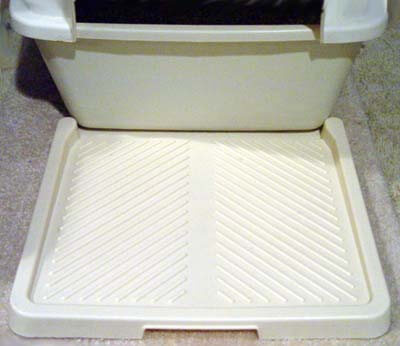
Litter mats are often used outside of the opening of a covered box or storage container to decrease tracking of the litter.  Do not use the plastic ‘grass’ mats or the mats with raised bumps on them as they are very uncomfortable for your cat to walk on, often leading to litter box avoidance.  Some people use carpet sections or towels but I prefer to use this litter mat shown below.  This mat allows the litter to fall into a lower tray so that you only have to tend to it every couple of weeks and this design also keeps your cat from walking on the litter.  Also, the lower tray will catch any urine if your cat accidentally aims out the door.

2012 update:  Unfortunately, the link that I had to this litter mat is dead; I do not think that it is being manufactured anymore.

litter-mat

Here is a picture of another type of mat that is very useful.  This particular brand is not made anymore but the Booda Litter Mat is close to it in design.  Whatever you choose to use, just make sure that your cat is comfortable when walking on it and is not reluctant to enter the litter box.
booda-mat

Children

Please do not force your cat to suffer with a dirty litter box because you’ve designated cleaning it as your child’s responsibility.  Children often cannot be trusted to maintain a litter box properly and your cat will suffer for it and, in turn, so will you when you are faced with an inappropriate elimination problem/soiled home.

Inappropriate elimination

First of all DO NOT PUNISH YOUR CAT.  Punishment will NOT help the situation and will often make matters worse.  Few things upset me more than when I hear about people actually rubbing their cat’s (or dog’s) nose in the waste as if this will help the situation!

Seek veterinary attention as soon as possible.

There are many medical reasons why cats stop using the litter box – many of which are strongly linked to the dry food that is fed to cats.  (Please see Feeding Your Cat: Know the Basics of Feline Nutrition)

Diabetes, kidney disease, cystitis (painful inflammation of the bladder), bladder or kidney stones are some of the more common medical problems that can lead to a litter box aversion.

Please see Urinary Tract Health.

VERY IMPORTANT:  If your cat is getting in and out of the litter box and is unable to pass any urine or is looking like he is distressed and wanting to urinate outside the box this is a MEDICAL EMERGENCY!  A cat with a blockage of the urinary tract can rupture his bladder within 24 hours resulting in death.  You may also notice a blocked cat or one with cystitis licking the genital area frequently.

A cat with cystitis will pass SMALL amounts of urine FREQUENTLY so also make note of the size and number of the urine balls on a daily basis. A 100 percent canned food diet with its high water and low carbohydrate content must be included in the treatment for any cat with cystitis, diabetes, or bladder stones.  In fact, all cats should be on 100 percent canned food or homemade diet.  Dry food is an illogical food source for a cat and causes many health problems.  Dry food, with its species-inappropriate water content, is not a friend of the urinary tract system – especially the bladder.

Once you have ruled out a medical issue, you need to evaluate your cat’s litter box system:

1)  Are you using an UNscented clumping litter?

2)  Is his box kept very clean?  Less than 3 items at a maximum?

3)  Is his litter box big enough?

4)  Is it in a safe location as far as he is concerned?

5)  Are there any feline housemates that may be tormenting him in the litter box – not allowing him to enter or exit?

6) Are there enough boxes?  Some cats like to urinate in one and defecate in another one.

7)  If you are using a covered box, have you tried taking the cover off?

8)  Have you tried using Dr. Elsey’s Cat Attract product? It comes as a ready-to-use litter or as an additive that you will need to add to an UNscented clumping clay litter.  It must be UNscented clumping clay since this type of litter has absolutely no odor to it.

Many people have had great luck with the Cat Attract products.  Fair warning…..many cats love this litter so much that they will roll in it at first.  I have never heard of a cat that keeps rolling in it or that rolls in it after the box is used.  I actually consider it a good sign when they roll in it since it is obviously very ‘attractive’ to them!  This behavior is usually temporary.

9)  If you are having problems transitioning an outdoor cat to an indoor cat and he is refusing to use the litter box, or if your cat prefers using your potted plants instead of his litter box, try using potting soil instead of clumping litter.  Once the cat has used the potting soil on a regular basis for a couple of weeks, you can gradually add a small amount of clumping litter to see if you can change him over.

You will need to empty the box at least twice daily when using potting soil and scrub the box each time.  Also please understand that by using this non-clumping substrate, the urine will soak into the litter box (plastic is fairly porous and easily impregnated with odors) with only a few urinations so I strongly suggest that you get a new litter box when you switch over to using the clumping litter and start with a fresh, clean box.

Conclusion

It is much easier to prevent an inappropriate elimination problem with a proper diet and sound litter box practices than it is to fix one once it starts.  Not all of the issues that cause cats to stop using the litter box are within our control but many factors are as outlined in this essay.

Back to top


Partial update November 2016
Lisa A. Pierson, DVMcounterlitterbox

Feline Obesity: An Epidemic of Fat Cats

Lisa A. Pierson, DVM

pdf-icon-darkFrench translation

May 2025 – this page was written many years ago but it is as relevant today as it was when it was first written.

~~~~~~~~~~~~~~~~~
When was the last time you saw an obese lion?  How about a chubby cheetah?  Or a fat tiger?  Have you ever seen an overweight leopard or panther?  If you have ever watched nature programs on TV, I am sure that you know the answer to the questions just posed.

The answer is “never.”

The next questions are also easy ones to answer – even if you are like me and turn your head when scenes of wild carnivores eating their prey pop up on the television screen!

Do these wild cats eat a dry food diet that is full of starchy carbohydrates in the form of grains?  Do they eat a water-depleted diet in the form of dry kibble?  Is their diet one that derives much of its protein from plants (versus meat) as is true of many dry food diets?

The answers are, again, simple:  “no,” “no,” and “no.”

There was a wonderful program on the TLC channel a few years ago entitled Honey We’re Killing the Kids.  This program addressed the obesity epidemic in this country – starting with what we are feeding to our children.  Americans are eating themselves right into an early grave but that is their choice.  Our cats, on the other hand, do not have a choice and are stuck with whatever their human caregiver decides to put on their dinner plate and we owe it to them to feed a healthy diet.

This webpage could be aptly named Honey, We’re Killing our Pets.

If you have not read my article entitled Feeding Your Cat: Know the Basics of Feline Nutrition, I urge you to do so now and then come back to this page.  In order for you to understand how to tackle feline obesity, you must first understand how to properly feed a cat.  After all, cats, like humans, do not become obese if they are eating a healthy, species-appropriate diet with their caloric intake properly balanced with their caloric expenditure.

Please note that I used the word “healthy” in the above statement.  People and animals can, indeed, maintain an appropriate weight even when eating an unhealthy diet.  So, to that end, it is very important to understand that even if you have a cat that is at an appropriate weight, this does not necessarily mean that he is eating a healthy diet.

As outlined in my Feeding Your Cat article, your cat has a much better chance of optimal health if he is fed a canned food diet instead of dry kibble.

Dry food is not a healthy diet for any cat because it is:

  1. water-depleted which is highly detrimental to the feline urinary tract;
  2. too high in carbohydrates which alters the blood sugar balance in many cats and contributes to obesity;
  3. derives much of its protein from plants, not animals, which runs counter to the metabolic design of the strictly carnivorous feline.

Please click on the links below to read more about the key issues associated with feline obesity.

Why are there so many fat cats?

How to evaluate your own cat’s weight

We owe it to our cats to feed them properly

Recognizing fat versus muscle

Implementing a safe weight-loss program

How fast should my cat lose weight?

How much should I feed?

Consider calories, not just ounces

Multiple cat households

Mistake made with Bennie – protein malnourishment

Case study – Molly

Case study – Bennie

Why Are There So Many Fat Cats?

penny-and-benny-blue-copy

Type of diet – dry kibble

Obligate carnivores are designed to meet their energy needs with calories supplied by protein and fat – not by carbohydrates.  The average prey (birds, mice, rabbits, etc.) of a wild cat is made up of only 3 – 5% of calories from carbohydrates.  Now consider that dry kibble diets generally range from 35% – 50% carbohydrate calories and you will see a serious disconnect between what the cat is designed to eat and what Man insists on feeding to them.  Dry foods flood the cat’s system with 5-10 times (500% – 1,000%) more calories from carbohydrates than what would be found in a wild cat’s prey.

According to Dr. Zoran’s paper The Carnivore Connection to Nutrition in Cats, carbohydrates are minimally used for energy by the cat and those that are not used are converted to, and stored as, fat.  The so-called “light” diets that are on the market have targeted the fat content as the nutrient to be decreased but, in doing so, the pet food manufacturers have increased the grain fraction (because grains are always cheaper than meat), leading to a higher level of carbohydrates.

Hence, many overweight cats eating these diets are still obese.  These “light” products are among the most species-inappropriate, unhealthy diets available to cat caretakers.  Many caretakers feed very small amounts of these diets hoping that their cat will lose weight but feeding a small amount of a diet that is inappropriate for the species is not the answer!  The caretaker usually just ends up with a crabby cat that is often still overweight.

Why are dry foods so high in carbohydrates?  Think ‘profit margin’.  Grains are cheap.  Meat is expensive.

Why are dry foods so popular?  Because they are cheap and convenient.

Our cats are a ‘captive audience’.  They depend on us, with our opposable thumbs and the common sense part of our brains engaged, to feed them a diet that promotes health – one that they would be eating if left to their own devices in a natural setting – not one that is just cheap and convenient.

Important note:  Feeding the least expensive canned food is far better than feeding the most expensive dry food.
When considering the issue of obesity, consider that dry food is only 10% water and canned food is 78% water.  Therefore, dry foods are more calorie-dense than canned food.

Method of feeding

Another very significant issue contributing to the obesity epidemic is the method in which dry food is often fed. Many people free-feed their cats.  However, think about what your human child’s waistline would look like if you put out a bowl of very palatable high carb food for them to eat whenever they wanted to!

Some cats will properly regulate their intake when dry food is free-fed but many will not.

There are three main reasons why cats tend to overeat when free-fed high carb dry food.  The first reason is because the pet food manufacturers do not play fair when manufacturing dry food.  They coat the kibble with extremely enticing animal digests which makes this inferior source of food very palatable to the target animal.  (Think about the last time you sat down with a very tasty meal or snack.  Did you eat well past the point that your stomach was satisfied in terms of ‘fullness’?  We all keep eating when we shouldn’t…….simply because it tastes good.)

The second reason that some cats tend to consume too many calories when eating dry food is because an obligate carnivore is designed to be satiated when he has consumed an adequate amount of protein and fat.  Carbohydrates do not seem to send the “I’m full and can now stop eating” signal to a cat’s brain like protein and fat do.

The third reason why some cats overeat is boredom.  This is especially true for indoor-only cats.

Of course there are many cats that are free-fed high carb dry food that do not gain an excessive amount of weight.  This variability exists in the human population also. Some living beings are simply more food-oriented than others.  Unfortunately, even these cats – regardless of their weight – are still being fed an unhealthy diet.

Activity level

An indoor-only cat will usually not burn off as many calories as an outdoor cat.  Also, as mentioned above, indoor cats often eat out of boredom (just like humans) and end up overweight.  Of course, the safest place for a cat is indoors but just because a cat lives its life inside, this does not mean that he has to be overweight.

Interact with your cat as much as possible using tassel toys, etc.  This will not only burn off calories but will also alleviate boredom.  Many people use laser lights but I always feel sorry for the cat since they are never able to actually catch their ‘prey’!  Some people hide small bowls of canned food around the house to make their cats roam around looking for their ‘prey meal’.

Here is a video of Bennie running back and forth in chasing 20-25 pieces of dry food (EVO grain-free) that he is getting as a treat.  This game allows for 20-25 calories out of his 180 calorie daily allotment.

Please do not fall for the marketing gimmick of the “Indoor Cat” formulas of food.  Cats did not suddenly stop being obligate carnivores just because they stepped inside under a roof.  These diets often have an atrocious list of ingredients and are usually loaded with high carb grains.

Here are two pictures of a cat that, on the outside, appeared to be at an acceptable weight – even on the thin side.  He was being fed a high carbohydrate dry food diet and you can see what his insides looked like.  All of the light colored tissue is fat.  There is so much fat inside of this cat that his kidneys (oval, pink organs) are barely visible.  Some of you may also have heard of ‘omental fat’ that human nutritionists and doctors talk about when discussing risk factors for death in overweight humans.  On the left side of the top picture and the right side of the bottom picture – you will see omental fat.

Right kidney surrounded by fat

left-kidney-fat-copy

Left Kidney engulfed in fat
right-kidney-fat

Is Your Cat Overweight?

You may be wondering if your cat really is overweight.  Generally speaking, I find that humans tend to think that a chubby cat is ‘cute’ and ‘healthy’ when, in reality, the cat is carrying around too much fat.

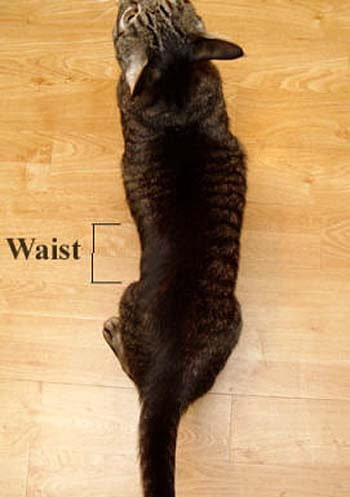
Note that you should be able to easily feel the ribs with just a slight fat pad over them.  Cats should also have a waist when viewed from above.  They should not have any fat pads over their shoulders and if you pick up their skin, you should not feel thick fat underneath.

Their top line (backbone and back of the head) should be well-muscled and not terribly prominent (too thin) or hard to feel (too fat).

The top line is the preferred area to assess/monitor during a weight loss program or as the cat ages.  This part of the body gives a very good indication of the overall body weight/condition of the cat.

calvins-waist-copy

Important note:  I do not consider loose skin on the underside of the cat’s abdomen to be a sign of being overweight.  Many cats (males and females) have this ‘doolap’ and if it is just loose skin – and not fat – this is nothing to be concerned about.  (My Amber – sporting her new ‘lion cut’ hairdo – gave me permission to post her doolap for the world to see.  She is well-muscled and not overweight…….but could use a tummy tuck.)

ambers-doolap-copy

Feeding Your Cat for Health

The feeding of dry food plays a very significant role in many of the diseases that plague our cats including obesity, diabetes, urinary tract problems, and inflammatory bowel disease.

See Feline Urinary Tract Health for a discussion of how a water-depleted diet causes a great deal of suffering in our cats.

Regarding feline diabetes, the links between dry food and this serious disease are two-fold:

  • Excess carbohydrates wreak havoc on many cats’ glycemic (blood sugar) balance.
  • Cats on dry food are much more apt to be overweight or obese.  Fat cells secrete a substance that can cause insulin resistance – leading to a diabetic state.

Most people are familiar with the Atkins diet which is based on a high protein/moderate fat/low carbohydrate calorie distribution.  Personally, I think that this diet is a bit extreme for humans since we are designed to consume carbohydrates in the form of vegetables and whole grains.  However, the cat is definitely designed to eat an Atkins-type of diet due to their metabolic make up that defines them as obligate carnivores.

This status is reflected by their lack of enzymatic pathways to efficiently utilize high levels of dietary carbohydrates.  This is why the feline species-appropriate diet is often referred to as the “Catkins Diet.”

It is important to understand the basic three elements of food/calories:

  • *protein
  • fat
  • carbohydrates

It is best to list foods in terms of caloric composition which reflects the percentage of total calories that come from protein, fat, and carbohydrate. The caloric breakdown of these three nutrient classes must add up to 100% of total calories.  Therefore, if one class of nutrient is decreased, one, or both, of the other two must increase.

*A very important note about protein: Not all proteins are created equal.  Proteins can either be from animals or plants.  What defines cats as obligate (strict) carnivores is their need to consume protein from other animals – not plants.

Protein derived from animal tissues has a complete amino acid profile. (Amino acids are the building blocks of proteins. Think of them as pieces of a puzzle.) Plant-based protein does not contain the full compliment (puzzle pieces) of the critical amino acids required by an obligate carnivore. The quality and composition of a protein (are all of the puzzle pieces present?) is also referred to as its biological value.

Humans and dogs can take the pieces of the puzzle in the plant protein and, from those, make the missing pieces. Cats cannot do this. This is why humans and dogs can live on a vegetarian diet but cats cannot. (Note that I do not recommend vegetarian diets for dogs.)

Grains (corn, wheat, soy, rice, etc.) are made up of proteins (plant-based – poor biological value) and carbohydrates.

Most dry foods are heavily grain-based but it is important to recognize that pet food  companies are sneaky.  Many of them put “grain-free” on the label but then fill up the food (and increase their profit margin) with peas and potatoes which are high in carbohydrates and are plant-based protein sources but are not technically “grains.”

Because the protein in dry food is often heavily plant-based, the overall protein content in this type of food earns a lower biological value score when compared to the protein in canned foods which is usually animal (meat)-based.

And, the grains/potatoes/peas in dry food also contribute a high carbohydrate load to your obligate carnivore’s body.

Because plant proteins are cheaper than meat proteins, pet food companies will have a higher profit margin when using these ingredients.

bennie-on-butt

Dry food addicts:  Unfortunately, many cats have been fed dry food for their entire lives.  It is no wonder that they are conditioned to eat this unhealthy diet.  If I had a dime for every time I have heard someone say “but my cat really….really likes his dry food” I would be wealthy.

People like cookies and potato chips but that does not mean that these food items constitute a health diet.

Cats that have grown up on dry food find the consistency of canned food very foreign and often refuse to even give it a try.

My cats had been fed a 100% dry food diet for their entire lives.  When I started introducing canned food to them in December of 2002, their ages ranged from 2 to 10 years.  They all looked at me like I had rocks for brains…..wondering what in the world that wet stuff was in their food bowls.  It took a very frustrating, three month-long period of time to get them off of dry food and eating canned food.  After transitioning to canned food, I took it one step further.  In March of 2003, I transitioned them to a balanced homemade raw or semi-cooked meat diet and I could not be happier with their health.

See Tips for Transitioning Dry Food Addicts to Canned Food.

Low carbohydrate dry foods:  There are three dry foods on the market that are lower in carbs than most dry foods but please do not think that these foods are a healthy option to low-carb canned food.

Three lower-carb dry foods on the market are Innova EVO, Wellness CORE, and Young Again.  While these foods do address the high carb issue, they are still water-depleted diets that should not be fed to a species that has an inherently low thirst drive.  Dry food sets your cat up for serious urinary tract problems.

Cats are designed to obtain water with their food since their normal prey contains approximately 75%  water.  Dry foods only contain 10% water whereas canned foods contain  approximately 78% water.  Canned foods therefore more closely approximate the natural diet of the cat and are better suited to meet the cat’s water needs.

People often say “but my cat drinks a lot of water so he must be getting enough!”

Because cats have a low thirst drive, they do not make up the hydration deficit at the water bowl when consuming a dry food diet.

It has been shown that cats on canned food – when compared to dry food-fed cats – consume double the amount of water when all sources (from the food and the water bowl) are considered.  This also means that their urine output is increased significantly which promotes urinary tract health by frequently ‘hosing out’ your cat’s bladder of crystals and any inflammatory debris.

Please understand that this necessitates more frequently cleaning of their litter box or the addition of more litter boxes in the home.  We need to always be respectful of the cat’s fastidiously clean nature and and have a clean litter box available for them at all times.

In addition to being water-depleted, these grain-free dry foods are high in phosphorus which is not a good mineral to have in abundance – especially for senior cats that may have marginal kidney function.

A third – and very important – issue is that these three dry foods are verycalorie-dense.  For instance, dry EVO contains a whopping 612 calories/cup.  Most dry foods are ~400 calories/cup or less.  Considering that the average 10 pound cat only needs about 200 calories per day to maintain their weight, you can see that 1/3 of a cup of EVO meets these caloric needs yet many people feed far more of this diet than 1/3 of a cup.

Combine a very palatable diet with high caloric density and throw in the fact that many people free-feed their cats dry food and you have a perfect recipe for obesity when these dry foods are fed. You can use these products as transition foods in order to cut the carbs in the diet but you must be very aware that these diets are very calorie dense and a ‘little bit goes a long way.’  Portion control of these diets is a must!

A fourth issue is that these diets, like all dry foods, are cooked for a very long time at very high temperatures.   Many vital nutrients are damaged or destroyed by this harsh cooking process and then Man has to guess which ingredients, and in what form and amount, will need to be added to restore the health of the diet.  Man is just not as smart as nature which makes it impossible to know exactly what has been damaged and how to restore the food to an optimal level of nutrition.

"Do I look thinner in this dress?"
“Do I look thinner in this dress?”

Ok…..we have discussed the fact that canned food is better for cats than dry food so the question is……what do we look for in a canned food?

Please see Commercial Food for a more detailed discussion on this subject.

Ideally, for an otherwise healthy cat, we want to feed a high protein/moderate fat/low carbohydrate canned food.  In other words, a mouse.

In terms of caloric breakdown that means approximately:

  • 45% protein (or more)
  • 45% fat (or less)
  • 10% carbohydrate (or less)

Keep in mind that when you are reading the Cat Food Composition chart, the protein, fat, and, carbohydrate calories (the first three columns) must add up to 100%.

Unfortunately, many commercial cats foods that fit the above criteria contain fish.  As is common knowledge, fish can be contaminated with heavy metals such as mercury.  Also, research has shown that fire retardant chemicals (PBDEs) are more highly concentrated in fish and there is a strong link between these chemicals and hyperthyroidism.  As well, fish is one of the most common hyperallergenic proteins for cats.

When choosing a canned food, think ‘feathers and long ears’….ie…poultry and rabbit and not so much fish.  Fish-based cat foods can be used to help transition dry food addicts to canned food but cats tend to get fixated on it and then will not eat a more suitable diet of poultry or rabbit.  Therefore, try to wean your cats off of fish as soon as possible.

Some cats do fine with beef but this protein source also tends to be hyperallergenic in some cats so I recommend staying away from beef if your cat has any gastrointestinal problems such as vomiting or diarrhea.

We have established the fact that canned is better than dry for overall health but…….. can a cat get fat on high protein/low-carb canned food?

You bet he can!

Even though high protein/moderate fat/low-carb canned food is a much more species-appropriate diet that is much less apt to cause obesity, a cat that eats more calories than he is burning off will end up with too much fat on his body.

However, most cats – especially those that were never overweight – can maintain a nice weight on free-fed canned food but portion control may be needed for some cats that need to lose weight.  Some cats that have lost weight with portion control can then switch over to free-fed canned food but most of these once-chubby cats cannot and will need portion control for life.

Many veterinarians recommend Hill’s Prescription r/d but I would never feed this diet in either the canned or dry form to any cat in my care.  Both forms are low quality diets and are too high in carbohydrates.  Canned r/d = 37% carbs and the dry = 36%.  These foods also contain a list of ingredients that are not species-appropriate.

Note that dry r/d was the diet that Molly had been on when she came to me – in horrible shape.  It is an atrocious diet.

Recognizing Fat versus Muscle

I recently heard a well-meaning fellow rescuer proudly comment that two of her foster cats had become “beefy” as if this was a favorable condition.  Unfortunately, she was missing the concept of what constitutes a healthy weight gain.  These cats had put on fat – not muscle so there was now nothing “beefy” about them.  They were soft as marshmellows……far too fat.   This person also fell into the all-too-common trap of not recognizing that these cats were actually at a healthy (lean) weight when they came into her foster care and were now overweight and not as healthy.

This foster person was feeding a high carb, dry food diet.

The lack of recognition of fat versus muscle is a very common problem that I see.  People must understand that there is a big difference between lean muscle mass and fat.  I often hear about people feeding dry food to “fatten” their cats up.  And, unfortunately, that is exactly what high carb food does – it adds too much fat to the body.  These cats would be much better off on a high protein, moderate fat, low carbohydrate canned food which would promote lean muscle mass instead of fat deposits.

Unfortunately, many humans end up ‘killing them with kindness’ and feed their pets right into obesity.

Remember…..think ‘Catkins diet’ for your obligate carnivore – high protein (animal-based – not plant-based), moderate fat, low carbohydrate.

Implementing a Safe Weight Loss Program

Please pay close attention to the area around your cat’s backbone and the back of his head.  Establish a baseline ‘feel’ for this top line area before you start his weight loss program.  If these areas become excessively prominent, this is a sign of muscle mass loss which can be an indication of protein malnutrition.The key is to go slowly with a goal of no more than 1-2% weight loss per week.

The biggest hurdle to overcome on the way to a svelte body for your cat is their fixation on dry food.  Please see Tips for Transitioning Dry Food Addicts and pay special attention to the statements regarding Hepatic Lipidosis (fatty liver disease).

Hepatic lipidosis (HL) is a life-threatening condition that can occur when a cat is either completely anorexic (not eating anything) for 48 hours or more or is consuming less than 50-75% of his daily caloric needs over several/many days.  It more commonly occurs when overweight cats are not consuming enough calories but cats that are carrying a proper amount of weight can also end up with HL.

These ‘calorie starved’ cats end up with fat deposition in their liver which destroys the liver cells.

Because HL can become an issue if weight loss occurs too rapidly in cats, I strongly urge you to invest in a scale – preferably a digital one that weighs to the nearest ounce or half ounce.  It is always a good idea to weigh all cats several times each year regardless of whether they are on a weight loss program or not.  Weight loss can be an early sign of disease so it is always helpful to monitor all cats’ weight on a regular basis.

For skittish cats, go slowly with the introduction of the scale.  You do not want them to be afraid of it!  Take a week or so to just feed them treats on the scale so they see it as a good thing.  My cats are trained to get on the scale when I just put it on the floor and say “scale” because they know they will get a treat if they do so.

If you decide to put the scale on the floor, make sure that it is a hard floor and not carpet.

Bennie was very well-trained to get on the scale:

Important:  Note that many human baby scales have a base that is narrower than the tray and may tip if the cat steps on the end of the scale versus closer to the middle. This will scare the cat and damage the scale.

Also, do not let your cat leave the scale on their own unless you have given them permission to do so. (Don’t laugh…some cats can be trained….sort of….)  If they are allowed to leave on their own, make sure you hold down the opposite end so they do not tip the scale.

This Red Cross Baby Scale weighs to the nearest 1/2 ounce and has a wide base so it won’t tip if your cat is trained to walk onto it.

Here is a Salter Baby and Toddler scale but note that it does not have a wide base.

I would never attempt to handle extreme cases like Molly and Benny without closely monitoring their weight every 2-3 days but even cats that only have a few pounds to lose should be monitored.

Safe Rate of Weight Loss

Please understand that your overweight cat took months to get into his current condition and that it will take months to safely lose the weight.  This is not a race but it is critical for you to stay the course and not give up.

A safe rate of weight loss is 1 – 2% of their current body weight per week.

For example, if your cat weighs 20 pounds, he can safely lose up to ~6 ounces per week. (20 pounds X16 ounces/pound = 320 ounces.  2% of 320 = ~ 6 ounces.)

1% would be 3 ounces per week – or 3/4 pound/month.

As your cat loses weight, the amount of weight that he should lose each week will decrease.

For example, if your cat is down to 16 pounds, his weight loss should slow to ~2.5 -5 ounces each week which represents 1-2% of 16 pounds.

How Much Should I Feed?

I cannot stress this enough – I can give you a formula that will provide an approximation of the optimal caloric intake for a safe weight-loss program but the bottom line is that you need to weigh your cat every 3-4 days to make sure that he is not losing weight too rapidly – or not losing weight at all.

Why is weighing your cat so important?  Because:

1) Every cat is different in terms of how they metabolize food and their caloric needs.

2) We have no way of knowing if the calorie information given out by the pet food companies is accurate.

Also, as stated above, it is very important to pay attention to your cat’s top line (back bone area) and the back of his head for signs of excessive loss of muscle mass.

There are three ways to arrive at a starting figure for the amount of calories to be fed.

First method:

The most accurate way is to calculate how many calories your cat is currently eating to maintain his not-so-svelte figure.  Then take 80% of those calories as a starting point.  Check the bag of dry food that you are feeding and see if it lists the calories/cup.  Most dry foods do list the calorie content on the bag but canned foods do not.  See the Cat Food Composition chart to see if the canned food that you are currently feeding is listed.

Second method:

Since most people free-feed dry food, the amount of calories consumed in a day is not known. In this case, figure out what you think your cat *should* weigh and plug that number into this formula:

Required calories per day = [13.6 X optimal lean body weight in pounds] + 70

Most female cats should weigh a nice, lean 10 -11 pounds.  Most male cats should fall into the 11 -13 pound range.

Using an optimal body weight of 12 pounds as an example, we come up with 233 calories/day as a starting point.

[13.6 X 12 pounds] + 70 = 233

This formula provides a very generous starting point (usually far too generous) so be aware that some (most) cats will not lose weight when eating the number of calories generated by this formula.  I would suggest feeding according to this formula for 10–14 days (or less) and then re-evaluating the caloric needs based on the cat’s weight loss, or lack thereof.

Of course, if during that period of time your cat is losing weight too rapidly, you will need to increase his calorie intake immediately but I can’t imagine any cat losing too much weight on the amount of calories that this formula generates.

If he is maintaining his weight on the number of calories provided by the above formula, reduce the amount by 20%.

General comment:  In my experience, I need to get patients down to ~180 calories/day, or even less, before they lose weight.

Third method (the ‘keep it simple’ method):

Too fat?  Feed less than what you are feeding.  Too thin?  Feed more than what you are feeding.  Just right?  You are feeding the correct amount.

Again, let the scale be your guide!

Consider Calories and Composition, Not Just Ounces

An average canned food contains ~30 calories/ounce.  The plain chicken and plain turkey Wellness products contain ~40 calories/ounce.  Some of the lower quality canned foods only contain ~20 calories/ounce.  So you can see by this wide range that you need to pay attention to calories – not just ounces of food.

For high protein/low fat snacks you can offer small pieces of chicken but remember that you are feeding a small cat, not a human.  A little bit of food can be significant in terms of calories.

Chicken meat:

Raw, lean, skinned leg/thigh meat  =  ~34 calories/ounce.

Cooked, lean, skinned leg/thigh meat  =  ~50 calories/ounce.

This site is a good source for calorie/nutrient content of many foods.

Multiple-Cat Households

Getting a single cat to lose weight in a multiple-cat household can be a challenge especially in a house like mine where the cats are free-fed.

Fortunately, many cats lose weight successfully even when they are free-fed canned food. For this reason, I would suggest simply getting all cats in the house to transition to a 100% canned food diet (free-fed or meal-fed) and then monitoring your overweight cat.  In most cases you will see a nice weight loss for the chubby cat and the other cats may lose a bit of weight but usually do not become too thin.  Of course, every cat is different and must be monitored individually.

If after a few weeks of the new diet for all of the cats, your chubby cat has not lost any weight, you will then have to figure out how to implement portion control.

If your cats are used to being free-fed, they can get used to being meal-fed.  This will make it much easier to deal with a feline obesity project.

It has been shown in humans that eating small meals more frequently keeps the metabolism ‘reved-up’ and helps with weight loss.  Given that small cats in the wild eat 8-10 (or more) small meals each day, it is also beneficial for your cat (both mentally and physically) to eat smaller meals more frequently.  If you work a regular job, then feed in the morning….again when you get home from work….and then before you go to bed.  This last feeding is especially important if you want to sleep through the night!

Even though most cats will adapt well to meal-feeding by increasing their calorie consumption at each feeding so that their total daily intake remains the same, there are some cats that do better when food is available to them more frequently than 3 times per day.

Bennie and Molly were two sweet obesity projects that were housed with my foster kittens.  This presented a dilemma with respect to Bennie because the kittens were being free-fed canned food and he needed portion control.

Molly, on the other hand, lost weight nicely even when there was canned food in front of her at all times.

To remedy the problem with Bennie, I set up a cage so that the kittens could go inside and eat at any time but Bennie could not enter the cage because the opening was too small.  I used a notched piece of PVC pipe as a rigid spacer to hold the door open the right amount.  I then used velcro strips to hold the door closed against the pipe. This cage happened to have a convenient feature in that the top opened so that could access the cage without having to open the door.

creep-cage-copy

I covered the cage with towels so that Bennie could not see the food inside which would have been hard on him mentally.

feeding-cage

Kitten leaving the creep cage after eating.

If you have a thin cat that does not eat very much at one sitting and is a die-hard ‘grazer’, then you can use a creep cage (if there is enough size difference between the thin and chubby cat) or you can leave canned food (please….no dry food….) out some place high up but only if your fat cat cannot jump up to get the food.  Be aware that once your chubby cat loses some weight, they will be able to jump up on just about anything if they smell food.

Some people have cut holes in boxes/crates that will allow a thinner cat to enter while not allowing a larger cat to gain access.

Other people have figured out ways to prop a door so that it is barely open…..just enough for a thin cat to enter the room where food is kept.

The problem with these methods – the cage, box/crate, room, or putting food up high – is that you really need a significant size disparity or a cat that can’t jump high.  Unless a cat is extremely obese like Molly and Bennie were, most cats can squeeze through an opening or muster up enough energy to jump up to get food.

Another option is MeowSpace.  This is a feeder system that can be programmed to work (open) off of a cat’s microchip.

Mistake made with Bennie

As mentioned above, Bennie was living in my foster room with other adults and kittens.  All were being free-fed canned Wellness (chicken or turkey).  This feeding protocol left me unable to monitor Bennie’s calorie intake so I had to be extra vigilant in monitoring his weight.

For the first few weeks, Bennie lost just a bit over 2% of his body weight per week.  He was bright, alert, and playful.  He continued along at this rate but 2 months into his program, he was approaching a 3% loss per week and I noticed a loss of muscle mass along his top line.

The problem was two-fold:  Bennie clearly was not consuming enough calories but the other issue was that Wellness is low in protein (30% of total calories) when compared to a cat’s normal prey of mice and birds (~50%, or more, of total calories) and that, coupled with his low food intake, combined to cause overall protein malnutrition which resulted in the loss of muscle mass.

This is a very important point!  The goal of weight loss for any living being is loss of fat while maintaining, or even building, muscle mass.  However, since our cats are not going to the gym, we aim for simply a maintenance of muscle mass.

As soon as I switched Bennie to a higher protein, lower fat diet, the change in his body was incredible.  The high protein (~45% of total calories) diet provided Bennie with the needed protein to quickly (within 3-4 weeks) regained much of his lost muscle mass along his head and backbone (top line).

Once Bennie’s top line filled back in, portion control of his higher protein diet enabled Bennie to start to lose fat again while he maintained his muscle mass.

Cats definitely can lose weight safely on Wellness (see Molly’s story below) but I would prefer using a higher protein diet or supplementing a lower protein diet (like Wellness) with some muscle meat chunks.

By adding lean muscle meat to a lower protein/higher fat diet like Wellness, you will increase the protein calories and ‘dilute out’ the fat calories.

When supplementing a commercial food with plain chunks of meat (chicken or turkey thigh or breast meat, for example) you must understand that meat is not balanced with respect to calcium levels.  When a cat eats his prey, he is consuming meat and bones.  The bones supply the necessary calcium in the diet.  Meat, alone, contains very little calcium.

Do not feed any more than ~15% of the total diet as plain meat.  For example, if you are feeding 6 ounces of canned food, you can replace 1 ounce of canned food with 1 ounce of meat so that you will be feeding 5 ounces of canned food + 1 ounce of meat for a total of 6 ounces of food. The added meat is now ~16% of the diet (1/6 = ~16%)

If your cat will eat this meat in chunk form, this will have the added benefit of promoting dental health.  Leave the meat in a large enough piece (or pieces) so that he has to chew it with his molars.

Chicken gizzards are also good for promoting dental health because they are more tough/fibrous than muscle meat in the form of thigh or breast meat.

I prefer to feed this meat raw because raw meat is tougher to chew than cooked meat.  You can rinse the meat off with water of if you are worried about the raw issue, you can par boil the meat so that the surface bacteria are killed.  Aim for just the outside ~10% to be cooked.

Molly’s and Bennie’s Weight Loss Journey

Molly and Bennie are two very sweet cats who were literally crippled by their owner’s misguided feeding practices.

Molly = 20.5 pounds.  Healthy weight = 10-11 pounds.  She is a small-framed cat.

Bennie = 27.5 pounds.  Healthy weight = 13-14 pounds.

Skip to Bennie

Molly

…made a great pillow for kittens…

molly-kitten-on-back molly-and-kitten-cage

Bennie
bennie-dog-sitting-copy

Let’s start with Molly’s story and see how she got to be obese on Hill’s Science Diet Light dry food – a diet that is atrocious in terms of quality and one that is inappropriate to be feeding to any cat.

Molly was adopted as a kitten from TLC Adoptions in 1997.  She was fed a diet of dry food only.  When her owners noticed that she was getting too heavy, they started feeding her Science Diet Light dry food.  She continued on her path to obesity and ill-health.  Molly was returned to the adoption agency in 2004 – terribly obese and limping from carrying around so much fat.  If she laid down on her side, it was very difficult for her to get up.  Molly’s coat was a mess – oily and full of dandruff.

molly-major-dandruff-copy

Her obesity prevented her from being able to clean herself properly and the result of this was a painful skin inflammation and infection around her anus and vulva – extending to her lower abdomen.

Unfortunately, I do not have a picture of her at her worst but see below for a picture of Bennie’s rear end/abdomen to get an idea of what Molly looked like.  Here is a picture of the sanitary shave that I did for Molly.  Hair traps urine, feces and heat making the area harder to keep clean and more susceptible to infection and inflammation.

One thing that this picture does not show is the skin fold dermatitis within the folds of her vulva. There was a large fat layer on either side of her vulva that trapped moisture and bacteria.  Since she was unable to clean herself, this resulted in a painful inflammation and infection.

molly-sanitary-shave-copy

After Molly was returned to TLC Adoptions, she was adopted to a man who ended up feeding her another very inappropriate and unhealthy diet that was prescribed by a veterinarian.  The diet was Hill’s r/d in the dry form.

Molly was fed a small amount of this food in a separate room twice daily.  This man then put a shock collar on her and put the transmitting wires around the food bowls (filled with an inappropriate diet of dry food) that were being left out for his other cats – all of which who were terribly overweight also.  Unfortunately for Molly, she was the one being focused on.

At this point, Molly was in great danger of developing hepatic lipidosis (“fatty liver”) which can be fatal if not treated in time.

Molly did not like the Hill’s r/d and was now being shocked every time she tried to squelch her hunger pains when going toward the food bowls filled with what she had been eating her entire life.

This wonderful, sweet cat was very depressed, confused, jumpy (from the shock collar) and in grave danger of becoming fatally ill.

Within hours of hearing of Molly’s horrible situation, I called the man to discuss having her returned to TLC Adoptions.  She would then be placed in my home for careful monitoring – both medically and nutritionally.

He agreed, saying that he was “tired of the mess that she was leaving around the house.”

Molly’s rear end was so sore and itchy from her lack of ability to groom herself, that she was dragging her rear-end on the floor and furniture in an attempt to clean herself and to relieve her discomfort.  The discharge from around her vulva was black and messy.

If you cringe at the above comments, just think how poor Molly felt!  Cats, by nature, are very clean/fastidious creatures and when they can’t clean themselves properly, it becomes a very stressful situation for them.

The First Day of the Rest of Molly’s Life…..

……and the beginning of a VERY frustrating time for me!

molly-20-5-lbs-copy

3/28/04

Molly is a horrible Kibble Addict and needs a 12-step program in the worst way.  I have said many, many times on various internet groups and during my consulting work that *all* cats *can* be switched to a proper diet of high protein/low-carb canned food and NO DRY FOOD, if the human is patient enough and tries enough tricks but I can tell that Molly is going to be a tough one.

Molly is fed dry food on arrival.  Trying to force a diet change on a stressed animal is never a good idea.  A few more days on a lousy diet is not going to matter but I will continue to offer canned Wellness, Fancy Feast, and lower quality canned foods like Friskies.  Unfortunately, she will not have any part of this healthier diet.

3/30/04

Molly is a pretty laid-back cat…not terribly stressed and she has had a couple of days to acclimate to her new surroundings.  I would give her more time on dry food if she was a nervous type of cat but since she is not……it is time to get serious.  I am starting to syringe-feed her *pureed canned chicken Wellness.  This is done very gently and slowly so as to not create a food aversion.  Interestingly, Molly does not fight the syringe-feeding so I am not too worried about a food aversion resulting from this feeding method although I will keep it in mind as a possibility.

*I puree the Wellness in a blender – one 5.5 ounce can with about 4-5 TBS of water added.  Important:  Run it through a wire strainer!  If you don’t do this, your syringe will clog.  (The food is thick – even with the added water – but if you bang the strainer on your bowl repeatedly, the food will flow through it.)

Amount fed:  Using the formula above to arrive at an approximate figure for needed calories, I make sure that Molly consumes 180 calories/day (one 5.5 ounce can of Wellness chicken) as a starting level.  Adjustments will be made based on her weight loss progress, or lack thereof.

Molly will be weighed every 2-3 days.

One 5.5 ounce can + 4 TBS of water is ~150 cc.  Molly had no trouble taking 50 cc at each meal.  She was fed 50 cc 3x/day.

See the Cat Food Composition chart for the calorie content of many commercial foods.

4/18/04

I have switched many kibble addicts to canned food and have never lost a battle but Molly is my toughest patient yet.  I have actually ended up in tears on more than one occasion out of utter frustration.  I know that the only hope for Molly to lead a normal life….one where she can run, jump and play – and clean herself properly… is for her to get off of dry food and start eating a proper diet of high protein/low-carb canned food or a balanced homemade diet…….but she has other ideas.

I have tried many tricks with her. Tuna, crumbling dry food or parmesan cheese on top of the canned food, dipping the dry food in a tiny bit of canned or even just the juice from the canned.  I have tried cooked and raw chicken and cooked fish.  I put a bit of canned food on her paw to see if she would clean it off.  No way.  Molly will not even eat a piece of dry food that has so much as touched any part of canned food!

In a nutshell, Molly does not recognize anything but dry kibble as food.

(Since Molly will be put back up for adoption, I want to get her on a commercial canned food instead of the homemade diet that I feed to my own cats.  Most people are not prepared to Make Cat Food and so switching her to a canned food is more appropriate.)

Now….before you get too discouraged by the above ‘frustration’ narrative, please understand that I was being a bit impatient with regard to Molly’s diet change.  She was a foster cat that needed to eventually find a loving home of her own and so I wanted things to move along a bit more quickly than was realistic for Molly.

PLEASE do not rush the diet transition.  PLEASE be patient and do not give up.  And be sure to read this regarding transitioning stubborn kibble addicts and pay close attention to the comments about Hepatic Lipidosis.

To give you an example of the timeframe that I am talking about, my own herd of kibble addicts (yes….I fed a 100% dry food diet for ten long years before I saw the error of my ways…..) took 3 months to switch from dry to canned.  And, yes, I was frustrated by the slow process but my cats were going to be with me for life and I was committed to the long, slow battle of wits and tricks. It really is not a race – but you do need to get to the finish line.

4/20/04

Molly goes to the clinic for a dental cleaning and ends up needing a couple of teeth extracted.  Because of her reluctance to eat canned food on her own, a feeding tube is put in which makes both of our lives MUCH…much easier!!  I can now feed her with much less stress to both of us and in much less time.  We are both very relieved.

molly-in-her-dress

Thanks for the new dress but does it come in a darker, more slimming color?

5/7/04

2.5 weeks after the feeding tube was put in, Molly returns to her carnivorous roots and starts licking the pureed Wellness from the syringe and eating canned food from a plate.  She is living in my foster room with other cats and kittens and I think that it is helping her to watch them eat their canned food. I will not remove the tube until she proves to me that she will consume enough calories by eating canned food on her own.

5/10/04

The feeding tube is removed since Molly is eating on her own.

Molly finally gets it!!

mindy-molly

molly-5-10-04-18_10-copy

From 3/28/04 – 5/10/04 = 43 days => 30 ounce weight loss.

~5 ounces lost per week

Her original weight was 20.5 lbs or 328 ounces.

5 ounces is 1.5% of 328.

7/18/04

Molly’s BIG DAY!!!!

Molly gets to go to her forever home!  (Thank you, Maurine….)

Molly’s Weight Loss Progression on 5 ounces/day of canned Wellness

Molly’s new mom was removing about 1 heaping tsp from the 5.5 ounce can of Wellness leaving 5 ounces as Molly’s daily intake.  This resulted in a nice weight loss pace.

3/28/04 – 7/18/04 (16 weeks)

20.5 pounds => 17.1 pounds = a loss of 3 pounds, 5 ounces —- 3.3 ounces/week = 1% of her body weight lost/week

3/28/04 – 9/1/04 (22.5 weeks)

20.5 pounds => 16.25 pounds = a loss of 4 pounds, 4 ounces —- 3.0 ounces/week

molly-16-25-pounds-9-1-04

3/28/04 – 12/22/04 (38.5 weeks)

20.5 pounds => 14.8 pounds = a loss of 5 pounds, 10 ounces — 2.3 ounces/week

Backslide……..

Well…..sometime in early 2005, Molly conned her mom into feeding her more than the 5 ounces.  Her intake was increased to 7-7.5 ounces/day which was a 40 – 50% increase over the amount that she was losing nicely on.  To us humans, a 2 ounce portion of food does not seem like a lot but you can see that jumping from 5 ounces to 7 ounces is a huge increase (40%!) in her caloric intake.

5/26/05

Molly weighs 16 pounds – a gain of 1.2 pounds in 5 months!  Even at this weight, however, there is a noticeable difference in how she moves.  She walks much better and no longer limps…..but…..she still cannot clean her rear end.

Her intake is reduced to 6 ounces/day.

9/1/05

16.25 pounds

6 ounces/day is proving to be too much for Molly.  Back to 5 ounces/day!

3/13/06

15.1 pounds => A loss of 1.1 pounds in 6 months.  She has a nice waist but still has a lot of fat around her shoulders.  She is active and running around and feels great!

9/12/07

It has now been 1 1/2 years since I have weighed Molly.  (I think that Molly has breathed a sigh of relief since she has not seen me walking up her driveway….scale in hand…..for her Jenny Craig weigh-in.)  On a good note, she now has a good looking, thin, boy-kitty friend named Pablo, also rescued by TLC Adoptions.  Molly and Pablo have actually been chasing each other around – pretty good for a chubby 10 year old girl and a 9 year old boy!  This sure makes me smile considering that Molly could barely walk when she first came to me.  She now runs and jumps and plays like a normal cat!

4/17/08

13.2 pounds

I am ecstatic…….I just visited Molly and she looks fantastic!  Her coat is incredibly shiny….no more of her former greasy coat loaded with dandruff.  Molly is very active and happy…..she now runs and jumps and plays like a normal cat.

Her backbone and head are well-muscled which means that she has lost a great deal of fat while maintaining great muscle tone.

She has been on 5.5 ounces of Wellness Chicken and Herring canned food per day and I could not be happier with the way that she looks.  She is still carrying a bit of fat (I am still thinking that there is a 10-11# kitty in there somewhere) but, overall, I am extremely happy with the way that she looks!!

Molly, Pablo, and their mom are all moving to Arizona soon so, sadly, I had to kiss Molly goodbye.  It has been a wonderful 4 year journey to get Molly back to being an active, healthy cat……an experience that I will truly treasure for life.

6/24/08

11.8 pounds

As you can see by her weight, she has lost more fat and looks great.  She has been eating the same amount but the key to her weight loss has been an increase in exercise in her new, very large home.

However, this is a very sad update……Molly has been extremely active and playful up until today.  It appears that she has had a stroke and it is doubtful that she is going to survive.

6/25/08

It is with great sadness that I announce the passing of our sweet Molly.  Molly was a very special girl.  She was incredibly kind, affectionate and very gentle. Molly was a wonderful companion to Maurine’s 90+ year old mother – providing Mrs. H with great comfort in her remaining days as the elderly woman dealt with advancing Alzheimer’s disease.  I know that Maurine will always be grateful for the comfort that Molly provided for her mother.

Thank you, Molly, for all that you taught me during our journey to find your inner svelt and healthy cat.

8/26/08

Bennie (see his full story below) went to live with Maurine on 7/9/08.  Although no kitty can ever replace our sweet Molly, Bennie is doing a great job of earning the key to Maurine’s heart.


Bennie

unhealthy-diet-30-pounds

7/30/07

Bennie was dumped at a city dog/cat ‘pound.’  His owners cited “health issues” as the reason for abandoning Bennie.  What fate were they expecting for him?  Did they really think that cats like Bennie get adopted?  Sadly, the ‘fate’ in my neck of the woods is euthanasia for cats like Bennie.

Bennie is only 4 years old.

8/2/07

A shelter volunteer sends me an email wanting to know if there is any room at Dr. Pierson’s Fat Camp for Obese Felines…..knowing what a sucker I am for nutrition ‘projects.’  I cringe….wanting another foster cat like want a hole in my head.  But….then I start praying that Bennie is not a diabetic and I know that I cannot just delete the email and continue on with my day.  (Diabetes is not an uncommon illness that plagues cats that eat an inappropriate diet of dry food.  Add in the issue of obesity and the chances rise significantly.  See diabetes for more information.)

8/7/07

I break down and go to the shelter to meet Bennie.  I review his lab work and there are no abnormal values. Hopefully, he will dodge the diabetes bullet since he is still young and will spend the rest of his life on an appropriate diet.

what-did-i-do-wrong

Painful/itchy…inflammed rear end – severe dermatitis – this is what happens when a cat gets so obese that that they can no longer clean themselves properly.

urine-scalding

Bennie was such a good boy for his bath.  He just plopped over on his side and seemed to really enjoy it when I gently washed his horrible skin condition and trimmed all of his overgrown claws.

bennie-half-up-2

There is a question as to just how much Bennie weighed when he entered the shelter.  The technician recorded 30 pounds on 7/30/07 but I question the accuracy of that value since only 8 days later, he weighed 26.5 pounds. I really hope that he did not weigh 30 pounds on the impound day because that would represent a very drastic and unhealthy rate of weight loss and fluid loss.  (Dehydration will also result in weight loss.)

I am going to use 27.5 pounds as a starting weight for Bennie as of the day that he was turned into the pound – 7/30/07.  I will use 26.5 pounds as his starting weight on the day that he came into my care which was 8/7/07.

Bennie will be weighed every 2-3 days.

bennie-on-scale-8-7-07-copy

His severe dermatitis/scalding will being treated with Preparation H until the scabs and loose skin comes off:

prep-h-copy

8/8/07

I observe what may be one of the “health issues” that his owners were referring to when they abandoned Bennie.  He is going in and out of his litter box up to 3 times within 30 minutes.  He is passing small amounts of urine each time.  This scenario illustrates why it is so important to use a clumping litter (always UNscented) for all cats.  Clumping litter allowed me to appreciate the following information:

  • Bennie was able to pass some urine and was not completely blocked which would have been a life-threatening emergency.
  • His urine balls were very small – grape size – indicating cystitis (bladder inflammation).

Many people make the big mistake of jumping to conclusions that the above signs are due to an infection and automatically think that antibiotics are warranted.  At least 95% of cats under 10 years of age that are not diabetic, in kidney failure, or have hyperthyroidism but are showing these signs have sterile cystitis – NOT an infection.  “Sterile” means that the inflammation is *not* due to an infection and antibiotics are *not* warranted.

Please see Feline Urinary Tract Health for more information.

In order to diagnose a bladder infection properly, a cystocentesis must be done.  This is a procedure that involves putting a needle directly into the bladder through the abdominal wall.  It is not painful for the cat and it ensures that a clean sample is obtained for a culture and sensitivity.  A C & S tells us if there actually is an infection present and which antibiotic to use on the bacteria that was grown in the culture.

But…..Bennie is too fat to easily perform a cystocentesis on so I had to do what I could to help make the decision to put him on antibiotics or not.

Bennie urinated in an empty litter box that was near his regular litter box and I could see that the urine contained blood.  The urine specific gravity (urine concentration) was high (1.050) which told me that the probability of an infection causing his cystitis was extremely low.  He is only 4 years old and is not diabetic, nor in kidney failure. Therefore, he will not be put on antibiotics.

Important note:  The presence of blood does NOT necessarily mean that an infection is present.  We must stop abusing antibiotics in these cases.

I will count on a high moisture diet of all canned food (with added water if he will accept it) to help keep his bladder flushed out and I will monitor his clinical signs.  I will also give him a bit of Buprinex for the pain since cystitis can be painful.  Cystitis is thought to be highly linked to stress and Bennie has been under tremendous stress lately.  Also, Pain => Stress.  Therefore, pain management is very important in moderate to severe cases of cystitis.

real-meat-no-more-dry-food

8/11/07

Weight = 26 pounds, 4 ounces

Bennie is losing ~1 ounce/day which is just under the 2% per week rate that is considered to be a safe rate of weight loss.

He is being free-fed canned Wellness with some meals of the raw rabbit diet that I make for my own cats thrown into the mix. (See Making Cat Food.)  I either feed it raw or lightly cooked depending on his mood.  I do this in order to increase the protein in the diet and decrease the fat.  (Wellness is a good commercial food but it is lower in protein calories than I would like for a weight loss diet.)

That said, I did not add any extra meat to Molly’s Wellness and she lost weight at a nice rate and maintained her muscle mass.

bennie-eating-raw-copy

Please do not add more than ~15% (by weight) plain meat to any commercial food.  Otherwise, you will risk feeding an unbalanced diet since there is no calcium in plain meat. (I feed a raw meat and bones diet to my cats.  The ground bone provides the necessary calcium.)

Bennie is not exactly a big eater.  I am lucky to get him to eat 5 ounces/day of the Wellness/rabbit mix for a total of ~180 calories/day.  Some days he eats even less – closer to 140 calories/day.  I am happy with the daily intake of 180 calories but 140 calories is less than his calculated needs for a safe weight loss.  He is not acting hungry and is not begging for food and is bright and alert and seems perfectly happy but given his very low caloric intake, I am worried about malnutrition.

Important:  Keep in mind that Bennie is just one individual cat and that his lack of caloric intake illustrates just how *very* important it is to have an accurate scale during this process to ensure that the patient is not losing weight too quickly!  Please error on the side of caution with your own cats and work with your veterinarian during the implemented weight-loss program to ensure that hepatic lipidosis does not set in and a safe rate of weight loss is maintained.

After 4 days of  using only Preparation H, I switched to corn starch to keep the area dry.  I still applied a bit of Prep H to the few remaining scabs to soften them in order to facilitate removal.

rear-end-8-11-07-copy

8/13/07

Weight = 26 pounds, 2.5 ounces

8/16/07

Weight = 25 pounds, 15.5 ounces

8/18/07

Weight = 25 pounds, 13.0 ounces

Bennie is now trained to get on the scale when I ask him to!

Bennie’s cystitis seems to be clearing on its own as is the usual course for sterile cystitis.  The urine balls are getting bigger and less in number and I do not see him going to the litter box frequently when I am with him.  I have not been able to observe his urine directly since he is going to the litter box every time.

There is a joke in veterinary medicine that says most cases of cystitis get better in 7-10 days with antibiotics and in a 1 – 1.5 weeks without antibiotics. Antibiotics need to stop being overused for this condition (sterile cystitis).

belly-rub-please-copy

8/19/07

Up to this point, Bennie has been eating 4-5.5 ounces of Wellness per day.  Sometimes I do mix in some Fancy Feast Chicken Feast to get him to eat more but from here on out, he is on his own with 100% Wellness available at all times.  He is now running (well….I wish that he was “running”) with my other foster cats (1 adult and 2 kittens) and so I will not be able to monitor his intake but will keep a very close eye on his weight and his top line.

8/22/07

Weight = 25 pounds, 5.5 ounces

Bennie has lost too much weight (7.5 ounces) in the past 4 days but he is acting like he feels great!  He is starting to play with Penny:

bennie-playing-with-penny

Even though the introduction to the other cat and kittens was done slowly (they were in separate rooms with a screen door between them for almost 2 weeks), Bennie may have eaten less over these past few days due to the stress of being in a new environment with new roommates.

Progress report:

8/7/07 –  8/22/07 = 15 days……18.5 ounces lost = 8.6 ounces/week = a little over 2% per week.

8/23/07

Weight = 25 pounds, 5.5 ounces

8/24/07

Weight = 25 pounds, 5.5 ounces

It is odd that he has weighed the same for the past 3 days but I am relieved that the rapid weight loss has stopped.

He had 2 golf ball-size urine balls in his litter box within 12 hours.  This is a vast improvement from 8/8/07 when he was urinating very small amounts frequently.

8/25/07

Weight = 25 pounds, 5.0 ounces

8/27/07

Weight = 25 pounds, 4.5 ounces

8/29/07

Weight = 25 pounds, 1.5 ounces

After one month of eating a species-appropriate diet of canned food and no dry food…..and losing 2.5 pounds, Bennie finally feels like playing!

bennie-jumping-copy

9/1/07

Weight = 24 pounds, 12.25 ounces

Progress report:

8/7/07 –  9/1/07 = 25 days…..28 ounces lost = 7.8 ounces/week

Now that he is down to 24.75 pounds, 2% of his current weight is ~8 ounces.  So Bennie should not lose anymore than ~ 8 ounces/week…… or ~1 ounce/day.

9/3/07

Weight = 24 pounds, 8.25 ounces

9/7/07

Weight = 24 pounds, 2.0 ounces

9/10/07

Weight = 23 pounds, 15.5 ounces

Weekly progress report:

9/3/07 – 9/10/07 = 1 week…..8.75 ounces lost this past week

Overall progress report:

8/7/07 – 9/10/07 = 34 days…..lost 2.5 pounds (40 ounces) = average of 8.2 ounces/week.  This represents a total weight loss of 9.4%.

This is *much* faster than I had planned for his weight loss program but he is becoming more active and playful each day and is still very bright and alert.  He is still being free-fed canned Wellness – only the grain-free ones.  There is food available to him 24/7.

am-i-skinny-yet-copy

Not yet, Bennie, but you’re getting there!

9/12/07

23 pounds, 12 ounces

Bright, alert and playful – interacting with the other cats.  I am still concerned that he is losing weight too fast and I hope that he is not quietly working on a case of hepatic lipidosis – or becoming malnourished.

Even though I am not a fan of Fancy Feast, I fed him some today……. but he really is only slightly more interested in FF than he is in Wellness.

9/14/07

23 pounds, 9 ounces

Even though Bennie is losing weight a bit more rapidly than I had planned for him, he is becoming more active and appears to be feeling great every day.  However, please do not allow your cat to lose weight this quickly.  Please stick to the 2% per week weight loss as a maximum.

I am continuing to free-feed him canned Wellness with a bit of Fancy Feast thrown in.  The Fancy Feast does not make up more than ~10 -15% of his diet.  Fancy Feast has always bothered me in terms of quality since it is a bit like “kitty crack”……meaning that most cats just love it and I have a jaded eye regarding the ingredient(s) that are contributing to this tremendous palatability.  I have no idea what is in the “artificial flavors” and prefer not to feed a lot of this food.  There is also the issue of by-products.  You will find my views on that issue here.

9/16/07

23 pounds, 7.5 ounces

Bennie tried to run up some stairs – the same stairs that he would only slowly lumber up a few weeks ago.  He actually sort of jumped up them!  Ok….it was not terribly graceful but it was a start.

9/19/07

23 pounds, 2.0 ounces

9/12/07 – 9/19/07 weekly progress report:

He has lost 10 ounces this past week.  That is 2.6% of his body weight.  (10 ounces is 2.6% of 23 pounds, 12 ounces……or stated another way…….23 pounds, 12 ounces is 380 ounces.  10 divided by 380 = 2.6%.)

9/21/07

22 pounds, 15.0 ounces

9/25/07

22 pounds, 10.0 ounces

9/29/07

22 pounds, 2.5 ounces

Bennie is becoming more active each day.  He used to slowly lumber across the room when I would call him…or he would just lie around and not move.  Now he is walking briskly in order to follow me around the room.

9/19/07 – 9/29/07 progress report:

He has lost 1 pound in 10 days.  This works out to be ~3% of his body weight per week.  He is losing weight too quickly.  I need to find a diet that he likes better so that he consumes more calories/nutrients.

bennie-22-2-5-9-29-07-copy

bennie-fitting-on-scale-bette-copy

bennie-scale-playful-copy

bennie-in-carrier-near-winnie-copy

10/6/07

21 pounds, 11.5 ounces

Bennie has lost 7 ounces in the past 7 days which represents just under 2% of his body weight.  He is becoming even more affectionate than he already was…..if that is even possible!  Bennie is a very affectionate cat but, in the past, he would tend to wait for me to come to him.  He was so large that he did not want to move around much.  Now I am tripping over him!!  He is constantly underfoot gazing up at me begging to be acknowledged and petted.

I am also happy to report that he actually broke out in to a run….ok…a medium trot…..to go after Dexter in play!  He is also running up a couple of steps in the foster room versus just lumbering up them.

One issue that makes me a bit sad, however, is that Bennie really wants to be with humans.  I am not able to spend much time with him and I am really looking forward to getting him adopted into a loving home with people who will appreciate his great personality and who will also feed him correctly.

Bennie will be available for adoption after he loses a bit more weight…….but good homes are so hard to find.

bennie-and-windy

10/13/07

21 pounds, 1.5 ounces

Bennie has lost 10 ounces in 7 days.  This represents a 2.9% loss this week and is not a safe rate of weight loss.  Even though he is becoming more active and playful each day, I am concerned about him.  I recently had to bring in 2 new foster cats and while Bennie is very good with other cats, I feel that this has stressed him to the point that he has decreased his calorie intake to a dangerous level.  I will be moving him to another room to see if that results in an improved appetite.

10/15/07

21 pounds, 0.0 ounces

I am not happy with the way that Bennie’s body looks.  He is losing too much muscle mass along his backbone and over the top of his head which is due to inadequate protein intake – ie – protein malnutrition.  Also, he stands a very good chance of not consuming enough essential vitamins and minerals with such a low food intake which will result in overall malnutrition.

Since he has been in with other foster cats, I have no idea how much he has been eating.  He is not thrilled with Fancy Feast anymore and will not eat plain meat baby food (supplemented with calcium and taurine) or any of the rabbit diet that I make for my cats.  I will start supplementing a small amount of EVO dry food – even as much as I hate dry food.  He will get 1/2 ounce (75 pieces) each day which will add 65 calories to his total caloric intake.

I will turn the EVO feeding into a game where I throw the pieces – one at a time – around the room so that he runs for them and gets some exercise.

10/17/07

21 pounds, 0.0 ounces

Playing with a mouse toy.

10/20/07

20 pounds, 12.75 ounces

Bennie seems a bit quiet today and would only eat 25 of his 75 pieces of EVO.  I am worried about hepatic lipidosis.

10/22/07

20 pounds, 15.5 ounces

Bennie has been confined to an adjoining room so that I can monitor his food intake.  He is separated from the other foster cats by a screen door (so he does not get too bored) and he likes to lie by the door and watch them.

He only ate 4 ounces of Fancy Feast today for a total of 110 calories.  That is not enough food for him.  He would not eat EVO today.

10/23/07

20 pounds, 14.0 ounces

Bennie is not eating very well.  He is still very affectionate but is not as active as he usually is.  I have started to syringe-feed him pureed canned Wellness.  (12 ounce can of Wellness + 3 TBS water.  Puree in blender, then run through a strainer.)

Blood drawn for CBC and panel.

All liver enzymes are normal except for one that is very slightly elevated.  An ultrasound of his liver showed no abnormalities but with his decrease in appetite, he runs the risk of developing hepatic lipidosis.  I will continue to syringe-feed him until I can put a feeding tube in him.

10/24/07

21 pounds, 1.0 ounces

Bennie is not happy about the syringe feeding and neither am I.  He is trying very hard to be good but it is very stressful for both of us.  The stress involved with syringe-feeding can cause a food aversion but more importantly, it is impossible to get enough calories into him via this method.  He will have a feeding tube put in tomorrow.

10/25/07

21 pounds, 3.5 ounces

Bennie did well with the general anesthesia.  While he was under, he got his teeth examined and cleaned.  (Anytime any of my cats go under anesthesia, they get a thorough dental exam and cleaning.)

I am feeding him pureed Wellness – Turkey and Salmon since it is lower in fat and higher in protein than the plain Chicken or Turkey.  I am adding in chicken baby food (meat only – no grains, no corn starch and no vegetables) to increase the protein calories and lower the fat content of his diet.  The food is being supplemented with vitamin E, B-complex, taurine, and calcium.  Meat baby food – without supplementation – is a very unbalanced diet.

Bennie is feeling much better this evening since he has been fed several meals through the tube.  He is purring up a storm and rolling over for belly rubs.  He will stay in his own room for most of the day, for now, so that he is not stressed by the other cats and I will feed him 4-6 small meals/day via the feeding tube.  I will let him out with the other cats for a couple of hours/day as long as he does not seem too stressed.

He is not being fed anymore dry EVO unless it is during a play session where I throw 25 pieces for him one at a time.

benny-feeding-tube-belly-rub-copy

bennie-feeding-tube-side

bennies-feeding-tube-copy

Video of feeding Bennie via his feeding tube:

This is not the best video….but it does show how relaxed Bennie is during his feeding.  I am feeding him ~60 cc at a time – filling two 30 cc syringes before getting started.  It takes me about 7-8 minutes to slowly inject the food through the tube.  If I go any faster, I see him swallowing as if the food is coming back up his esophagus.

The food is always ‘chased’ with about 5-7 cc of water to keep the tube flushed.

The collar that I made for him is a safe collar.  It is a strip of elastikon tape folded lengthwise on itself so that it is not sticky.  I cut two slits in it on the left and right side of center for the tube to feed in and out of.  The two ends of the collar are taped together.  This collar would break apart if he ever got it caught on anything.

I added a strip of elastikon tape to the tube itself just to provide more bulk/friction so that it does not back itself out of the holes in the collar.

11/1/07

21 pounds, 0.0 ounces (the same as he weighed on 10/17/07)

I am feeding Bennie enough via his feeding tube to maintain his weight. I do not want to see him in a negative energy balance for weight loss at this time.  For the first week of feeding him with the tube, he was getting 60 cc of food 4 times/day for a total of 240 calories.  The food that I am feeding is still a mixture of Wellness Turkey and Salmon with chicken baby food mixed in with added supplements for balance.

Feeding Bennie 4 times/day is a bit of a hardship with my busy schedule so he is now being fed 70 cc 3 times/day and he has canned Wellness available at all times if he chooses to eat on his own.  He is back out in the large foster room with the rest of the cats and seems to be doing well.  He is very happy to see me when I come into the room and he rubs around my legs.

11/6/07

21 pounds, 0.0 ounces

Bennie is feeling great and so I will start to cut back on his calories to get him back on the road to a thin body.  I will be feeding him 200 calories/day.

11/28/07

20 pounds, 6.5 ounces

Average loss of 0.9% per week.

I removed Bennie’s feeding tube today.  He had the tube in for 5 weeks but I really only used it for the first 2-3 weeks.  For the past ~2+ weeks, he has only received a few meals via the tube while I monitored his food intake. I probably could have removed it 2 weeks ago but wanted to play it safe.

12/1/07

20 pounds, 3.5 ounces

Bennie is playing really well these days and he actually ran after another foster cat and tackled him in play.  They were grooming each other afterward.  This is quite a breakthrough for Bennie.  I have never seen him move so fast!  I also saw him roll over today like a normal cat.  He was not able to do that when he was so obese.

12/11/07

19 pounds, 14.5 ounces

Bennie finally broke through the 20 pound barrier!  And…..he can even jump up on this very high bed effortlessly!  Once I knew that he was jumping up onto the bed, I put a carrier there for him to use to get down.

bennie-on-bed-12-11-07-copy

A cat as large as Bennie should not be jumping down on his little legs.  If he were to do so, he could injure his joints and other soft tissues (tendons and ligaments).  In fact, he jumped out of my lap a few days ago when I was sitting on a low step.  He then limped off on his right front leg.  He needs to lose a few more pounds before it will be safe for him to jump down off of anything.  Damage to joints and soft tissues……a sad reality of obesity…..

bennie-waist-12-11-07-2-copy

Bennie is currently eating 5 ounces of canned Wellness – either plain Chicken or plain Turkey.  (200 calories/day)

12/18/07

19 pounds, 15.5 ounces

I am not happy with Bennie’s topline.  He is losing too much muscle mass around his back bone and head.  While Molly maintained her muscle mass when losing weight on Wellness, this diet is a proving to be too low in protein for an optimal weight loss program for Bennie.

Bennie was switched to a higher protein diet with 45% of the calories coming from protein.

12/24/07

20 pounds, 2.5 ounces

Video of Bennie playing:

I have not been spending as much time playing with him as I should be.  As with all diets…..it is calories in and calories out and Bennie needs to burn off more calories.  The exercise will not only help him to lose weight but it will also build muscle.  Hopefully, he is gaining muscle mass due to the fact that he is now on a higher protein diet.

I will be cutting back on his food slightly and exercising him twice daily for at least 10 minutes each time – or until he chooses to stop.

1/5/08

20 pounds, 0.5 ounces

Bennie is feeling great and he is playing well and for a longer period of time each day.  Just like with humans, cats need to exercise!  And…..just like with humans, their level of fitness will increase as time goes on.

I am very happy with Bennie’s top line after only 18 days on the higher protein diet.  His backbone has filled in with muscle and it is not prominent like it was a month ago.  Wellness Chicken and Turkey canned foods derive only ~30% of their calories from protein.  The Wellness Turkey & Salmon provides ~37% of its calories in the form of protein.

1/11/08

19 pounds, 13.5 ounces

~1% weight loss this week

1/22/08

19 pounds, 11.0 ounces

Bennie has lost ~8 ounces in the past month.  I am trying to run him around with a tassle toy twice daily – if my schedule permits it.

The muscle around his backbone and head is much greater since I switched him to a higher protein diet 1 month ago.

1/25/08

19 pounds, 8.5 ounces

1/29/08

19 pounds, 10.5 ounces

2/5/08

19 pounds, 9.5 ounces

Bennie’s weight loss seems to have stalled a bit but that is actually a good thing. He has been putting the muscle back on that he lost when he was not consuming enough calories.

2/23/08

19 pounds, 2.0 ounces

Bennie has been eating approximately 180 calories/day.

Here is a video of Bennie jumping up onto the bed. He flies now!!

It has taken Bennie almost 3 months to lose this last ONE pound but that is just fine.

3/5/08

18 pounds, 15.5 ounces

I am keeping a close eye on Bennie’s backbone and head area.  Both of these areas are filling in very nicely.

He ran really fast today when chasing his tassel toy!

3/9/08

19 pounds, 0.5 ounces

Bennie’s muscle mass continues to improve on the higher protein diet.  The back of his head is still filling in and is close to being normal now.  His top line is also normal with plenty of muscle around this backbone.

I have been feeding him some large chunks of chicken thigh meat for his dental health.

Bennie was a bit clueless when I first put the chunks of meat in his bowl.  He had that look on his face that my own cats get….”Mommy….please cut my meat for me.”  My cats are horrible about eating chunks of meat and their teeth are suffering for it.  I told Bennie to “tap into your inner carnivore and chew it!”  He figured it out because it was gone when I came back to his room.

3/13/08

18 pounds, 14.0 ounces

Bennie has lost 4 ounces (1/4 pound) in the past 20 days.

3/22/08

18 pounds, 10.5 ounces

Bennie has lost 6 ounces in 2 weeks.  This is just shy of 1% per week which I am very happy with.

3/30/08

18 pounds, 7.5 ounces

Bennie did not get any cooked chicken this weekend but he has been getting 22 pieces of dry EVO (20 calories) daily (or ever other day) that I throw (one at a time) around the room for him to run after.  I told him that I am not trying to tease him but, instead, I want to make him work a bit for his food!  Plus, it is a bit of a game for him.

4/5/08

18 pounds, 6.0 ounces

Bennie has lost 4.5 ounces in 2 weeks.  He is on target for losing 1/2 pound/month.

I would like to see him at ~14 pounds (I reserve the right to revise that….) so that means he needs to lose another ~4 pounds which may take another ~ 8 months.

4/10/08

18 pounds, 6.0 ounces

I think that Bennie is getting a few too many ‘sprinkles’ of EVO…..

4/15/08

18 pounds, 4.0 ounces

4/24/08

18 pounds, 1.0 ounce

His topline is now well-muscled and he is thriving on.  He is also very energetic when he plays and can run fast , turn on a dime and easily jump up on things ….just like a cat should be able to do.

bennie-4-24-08-18-2-0

For comparison – Day 1 picture….pre-8.5 pound loss:

bennie-on-scale-8-7-07-copy

Bennie and his buddy, Beau

bennie-and-beau-in-bed

5/3/08

18 pounds, 0.0 ounces

5/8/08

18 pounds, 0.0 ounces

I recently rescued a litter of kittens that are in an adjoining room to my foster room where Bennie is.  They are being free-fed canned (adult) Wellness but if their bowls are empty, it is hard for me to feed them and not give Bennie a tiny bit (less than a teaspoon).

I don’t like to see Bennie get frustrated when he sees me feeding the kittens so his weight loss has stalled a bit (for the past 2 weeks) but we will get back on track soon.  It won’t hurt him to be on a bit of a break from his weight loss – as long as he is not gaining weight.  I knew that this would be a marathon – not a sprint – when we started down this road 9 months ago.

I really am anxious to find Bennie a home of his own but it is going to be hard to find someone to stay the course with his program.  We have come so far and it would kill me to see someone adopt him who will not be committed to keeping him on track for at least another 2 pound weight loss. Or worse…..adopt him to someone who will allow him to become obese again.

5/10/08

17 pounds, 14.0 ounces

Bennie broke through another barrier!  It is so nice to see the ’17 pounds’ above.

He ran like crazy today for his tassel toy.  It is a joy to see him act more and more like a real cat every day.

The one sad part for Bennie is that his buddy, Beau, just got adopted by a wonderful family.  I need to get Bennie in a home of his own.  He is really tired of being in my foster room and cries when I leave him.  Bennie LOVES people and is a very affectionate lap cat.  As soon as I sit down……he is in my lap.  He loves to be brushed and craves more attention than I can give him…..

5/22/08

17 pounds, 10.5 ounces

6/3/08

17 pounds, 9.0 ounces

I can sure see why people fail at getting their cats to lose weight in multiple cat households.  Bennie is living with 5 kittens who need to eat a lot.  It is hard to say “no” to him when he sees the kittens eating and can smell the food.

I have been feeding the kittens 3-4 times/day and Bennie has to go into a large cage for about 15 minutes while they eat so instead of feeding him 2.4 ounces twice daily, he is getting smaller portions more frequently. I never put him into the cage without some food as I think that would be mental torture for him!

I sometimes take 1/2 tsp of Wellness canned food and smear into a plastic Lean Cuisine dish so that he has to work a bit to lick it out of the corners.  This keeps him busy while the kittens are eating.  It reminds me of when my mom used to let my brother and I lick the beaters with cookie dough on them!

6/22/08

17 pounds, 6.5 ounces

It has taken Bennie almost 3 months to lose just one pound.  As you can see by the picture below, Bennie is still too heavy.  He still has more fat on his frame than he should have.

I find that people allow their cats to carry far more fat on their bodies than they should.

Bennie and I will keep moving forward. Slowly but surely……. he will eventually end up fit and trim!

7/1/08:

A bitter sweet announcement………..

It is with great sadness that I announce the passing of our sweet Molly on 6/25/08 due to a stroke.  Even though we miss her terribly, we take comfort in the fact that she had a wonderful 4 years with her adoptive ‘mom,’ Maurine.  Her final days were spent watching the wildlife out the window of their new home in Arizona and playing with her kitty friend, Pablo.

When Molly first went to live with Maurine, she was a wonderful and comforting companion to Maurine’s elderly mother who was suffering from Alzheimer’s disease.  Maurine’s mother really brightened up when Molly came to live with them and she enjoyed having Molly sleep with her and keep her company on the couch.  We all know how soothing the presence of a furry one can be and Molly really did her ‘job’ well.

Now….on a happier note, in Molly’s honor, Maurine has decided that Bennie needs to move to Arizona to keep her and Pablo company.  I could not be happier….except, of course, if we still had our Molly…..

I know that Molly would approve of Bennie’s move to Arizona….knowing that she will never be replaced in Maurine’s heart but, instead, she would be thrilled to know that another once-obese kitty will have a chance at a healthy life with her ‘mom’.

The timing of Bennie’s new adventure into his hopefully forever home could not be better. (I say “hopefully” because Pablo also has to approve of his new housemate….)  Bennie’s weight loss has really stalled in my cat room.  He is currently at:

17 pounds, 8.0 ounces

He has not lost any weight in the past 3 weeks.  He is still on 1.5 ounces of Feline’s Pride 3 times per day for a total of 4.5 ounces per day but his weight is not budging. And….truth be told……he is also getting a tiny bit of Wellness and a few pieces of EVO…and I think that the calories are adding up.  It is just so hard to deny him when he smells the Wellness that the kittens are getting.

This is a picture of one of my foster kittens coming out of their feeding cage.  This is a very large cage that I have covered with towels so that Bennie cannot see their food.  They are young and need food available to them for most of the day….but I have to keep Bennie from getting to it.  In order to do that, I cut a short piece of PVC pipe and notched it so that the cage bars would fit into it.  I then wedged it so that the door would not close all the way but would stay open just enough for the kittens to squeeze through but not Bennie.  I used velcro strips to close the door against the pipe:

feeding-cage

It has also been impossible to exercise Bennie because there are 7 kittens living with him and they all run for the tassel toy….and Bennie just sits back and watches.

Instead of feeding him less, I will keep him at the same level and ask Maurine to do the same.  If I fed him less, I would worry about nutrient malnutrition so we need to increase his exercise to burn off calories. 

Since he will be going from my foster room to a 3,000 square foot house I want to see if an increase in activity level will cause him to drop the needed weight.  Maurine has bought tassel toys, a food scale, and a scale for Bennie so she will keep working at his weight loss program.

I would love to see Bennie get down to ~16 pounds, but if he never lost another ounce, he is so much healthier than he was when he came to live with me 11 months ago.

I can’t say enough nice things about Bennie. He has been a joy to work with….and cuddle with for the past year.  He is kind, gentle, and very affectionate and I will truly miss him…….

bennie-lap-time-copy

7/3/08:

17 pounds, 5.0 ounces

7/8/08:

17 pounds, 6.5 ounces

I just fed Bennie a good sized meal (4 ounces) before packing him up to make the 8 hour drive to his new home.  I rented a large SUV so that Bennie could ride in style in a big cage with a large litter box and nice cushy bed.  Bennie is microchipped and wore a collar with 2 phone numbers on it for the trip.

bennie-cage-suv

7/9/08:

17 pounds, 1.5 ounces – On Maurine’s scale.

7/15/08:

17 pounds, 3.0 ounces

Bennie traveled well and settled in nicely.

bennie-on-bed-maurines

Bennie and Pablo:

bennie-and-pablo-on-bed

8/10/08:

16 pounds, 13.0 ounces

Wow!!  I am thrilled with the fact that Bennie has lost weight nicely in his new home.  His food amount has stayed the same or maybe increased a bit but the key is that he is in a large home getting lots of exercise.  Maurine reports that he does run through the house!

It is so wonderful to see him happy in his new home and he took to Maurine very quickly.  He is a lap and bed snuggler. In fact, there are times when Pablo is in Maurine’s lap and Bennie joins in.  That is a lot of fur in one lap! (Pablo usually is the gentleman and jumps down….leaving the lap for Big Ben.)

4/14/09:

18 pounds, 7.0 ounces

Well…….things fell apart a bit over the past 6 months with Bennie consuming too many calories leading to a 1 pound, 10 ounce weight gain.  Bennie has been getting 3 meals per day and Maurine was going to cut out lunch but I recommended to keep feeding 3 times per day but just cut the calories down for each meal.

Maurine thinks that Bennie was probably getting ~250 calories/day which proved to be too much for him.  Bennie needs to stay at 200 calories, or less, in order to lose weight.  250 calories is 25% more than 200 calories so it is a significant increase.

6/22/09:

18 pounds, 15.0 ounces

Hmmmmm……stricter portion control needs to be implemented.

7/10/09:

18 pounds, 14.0 ounces

8/13/09:

18 pounds, 6.0 ounces

A loss of 8 ounces in 1 month – now we are headed back in the right direction!

10/9/09:

18 pounds, 4.0 ounces

1/3/10:

17 pounds, 14.0 ounces

A loss of 6 ounces in 3 months.  It is nice to see ’17’ again!

We are going to hold him at 200 calories/day for now but will re-evaluate him in 1 month and adjust his caloric intake from there.  My biggest concern is that the chance of developing diabetes increases significantly with every pound of fat on any body – human or cat.  Diabetes is a very serious and complicated disease to treat.  Therefore, I really do want to see Bennie lose more weight.

bennie-hind-legs-re-size

bennie-top-line-re-size

When I asked Maurine if Bennie runs around much her reply was:

“YES!  He and Pablo chase each other around the house several times a day, plus they both bat the “mousies” around the room…plus crazy meowing Ben races around the house by himself, chasing who-knows-what and hollering at ‘it.’  Sometimes Ben thunders up and down the hall and does the ‘slip and slide’ thing on the hall rug in the morning before breakfast.”

Reading that report put a huge smile on my face!  To understand my elation at Bennie’s ‘re-birth,’ one only has to look at Bennie’s first few pictures above…..taken when he was terribly obese…..discarded by his thoughtless humans when they dumped him at the ‘pound’…..

3/27/10:

17 pounds, 5.0 ounces

Bennie has lost 9 ounces since 1/3/10.  He is still eating 200 calories/day divided between 3 meals.

6/8/10:

16 pounds, 15.0 ounces

It has been awhile since Bennie has seen the number ’16’ in the pound column!  He is still eating 200 calories of a 45% protein diet per day divided into 3 meals.  Bennie continues to be very playful and active and he is as affectionate as ever.

6/18/11:

17 pounds, 13.0 ounces

Bennie has put on almost 1 pound since his last weigh-in so Maurine is going to watch his calorie intake a bit more closely.

He is still feeling great and is his usual lovable furry self but I would like to see him get back to the 16 pound range.

ben-on-his-indian-rug

9/25/11:

20 pounds, 3.0 ounces

19/22/11:

20 pounds, 9.0 ounces

12/14/11:

21 pounds, 4.0 ounces

Bennie continues to gain weight which is very disappointing.  I really fear that he is going to end up with diabetes if he does not lose weight.  Diabetes can be a very difficult and time-consuming disease to manage and is highly linked to excess body fat in both humans and animals.

3/24/12:

20 pounds, 9.0 ounces

Mid June 2012:

19 pounds, 8.0 ounces

7/27/12:

19 pounds, 9.5 ounces

10/10/12:

19 pounds, 12.0 ounces

1/23/13:

19 pounds, 6.0 ounces

4/24/14:

21 pounds, 3.0 ounces

Very sad update….We lost Bennie to kidney cancer in the middle of 2015.  He left behind many people and “Pablo,” his best fur-buddy, who miss him terrible.


Updated February 2013
June 2014
May 2025
Lisa A. Pierson, DVMcounterobesity

Primary Sidebar

Search Catinfo

ORIGIN of CATINFO

  • Dr. Pierson – How CatInfo Came to Be

FELINE NUTRITION

  • Feeding Your Cat: Know the Basics of Feline Nutrition
  • “Prescription” Diets
  • Transitioning Dry Food Addicts to Canned Food
  • The Carnivore Connection to Nutrition in Cats
  • Commercial Cat Foods
  • Protein/Fat/Carb/ Phosphorus Chart
  • Making Cat Food

FELINE HEALTH

  • Urinary Tract Diseases
  • Diabetes
  • Obesity
  • Hyperthyroidism
  • Vaccines
  • The Litter Box
  • Feeding Tubes
  • Dental Health
  • Pilling Cats and Dogs Safely
  • Convenia/Solovecin: Long-Acting Antibiotic

RESCUE

  • TLC ADOPTIONS
  • Drop Trap/Remote Control Trap
  • Building A Folding Drop Trap
  • Alley Cat Allies Drop Trap Review

RECOMMENDED READING

  • Your Cat – Dr. Elizabeth Hodgkins
  • Canine Nutrition: Feeding Miss Lilly – Dr. Christine King

EXTRA STUFF

  • Dr. Pierson’s Tall, Dark, and Handsome Men
  • Robbie’s Barium Study
  • Interesting Pictures
  • Ant problem solution
  • South Bay Pet Stores
  • Contact

Copyright 2026 CatInfo.org - All Rights Reserved - Sitemap


Website Design by Stellar Websites
MENU
  • ORIGIN of CATINFO
    • Dr. Pierson – How CatInfo Came to Be
  • FELINE NUTRITION
    • Feeding Your Cat: The Basics
    • “Prescription” Diets
    • Transitioning Dry Food Addicts to Canned Food
    • The Carnivore Connection to Nutrition in Cats
    • Commercial Cat Foods
    • Protein/Fat/Carb/Phosphorus Chart
    • Making Cat Food
  • FELINE HEALTH
    • Urinary Tract Diseases
    • Diabetes
    • Hyperthyroidism
    • Obesity
    • Vaccines
    • The Litter Box
    • Feeding Tubes Save Lives
    • Pilling Cats and Dogs Safely
    • Dental Health
    • Convenia: Long-Acting Antibiotic
  • RESCUE
    • TLC Adoptions and Rescue
    • Drop Trap/Remote Control Trap
    • Alley Cat Allies Drop Trap Review
    • Building A Folding Drop Trap
  • RECOMMENDED READING
    • Your Cat – Dr. Elizabeth Hodgkins
    • Canine Nutrition: Feeding Miss Lilly – Dr. Christine King
  • EXTRA STUFF
    • Dr. Pierson’s Tall, Dark, and Handsome Men
    • Robbie’s Barium Study
    • Ant problem solution
    • Interesting Pictures
    • South Bay Pet Stores
    • Contact