Lisa A. Pierson, DVM
Hello CatInfo readers,
I am often asked what led to the creation of catinfo.org and what fuels my passion for doing as much as I can to help cats from all over the world live long and healthy lives.

The second part of the question is easy to answer: I really love cats.
The first part of the question takes a bit more explaining.
I never imagined that I would become such an outspoken veterinarian regarding matters of optimal feline nutrition and care given that my primary focus straight out of veterinary school was equine medicine. I never dreamed that I would end up writing pages and pages detailing how to make a healthy diet for cats, or passionately discussing the prevention and management of feline diabetes and urinary tract diseases, or writing about the dangers of ‘dry pilling’ cats, or putting a litter box-cleaning video on the internet especially considering the fact that the World Wide Web was years away from even existing when I graduated from the University of California, Davis School of Veterinary Medicine in 1984!
So how did I become so deeply passionate about cat nutrition, general care, and the various medical conditions that affect the cats that we share our lives with?
Austin, Robbie, and Anne Jablonski.
Let’s start with Austin who I am pretty sure was a long lost love from a former life. I adopted Austin from a shelter when he was 4 years old. His time was running out and I am a sucker for the adults that nobody wants. Plus, brown tabbies really do something for me. Our hearts were instantly connected and when I had to say goodbye to him in 1998, I was devastated. I still cry over him.
After losing Austin, I wanted to do something to honor him so I started volunteering with a local cat rescue organization, TLC Adoptions, to pay tribute to my very sweet boy. Over the next 13 years, I rescued and placed approximately 550 cats and kittens in homes. Unfortunately, I saw very quickly that we could never adopt our way out of the overpopulation crisis since  the math just does not add up. There are FAR more kittens being born each minute than there are available homes.
The answer lies in getting humans to become more responsible about spaying and neutering.
During my years of involvement in the rescue world, I spent many long hours doing TNR work (Trap/Neuter/Return) of feral (wild/unowned) cats in order to prevent the suffering endured by homeless cats and kittens living in a concrete jungle, and to try to make a dent in the large number of unwanted kitties that lose their lives in shelters every day.
I would often go on periodic 3-4 day-long trapping marathons to stabilize large feral colonies using traps that I designed and built for increased efficiency. This would entail starting to trap at around 7 or 8 PM, staying out until 4 or 5 AM, then performing surgery until all of the cats were spayed or neutered. After a few hours of sleep, I would get up and start all over again.
I wish that I could say that rescue work is all about warm and fuzzy feelings – and no sadness – but that could not be further from the reality of the situation. After spending 13 years heavily involved in rescue work – and having it exact a tremendous toll on my heart – I am now taking a break and concentrating more on helping cats live better lives all around the world through my website.
So how does my precious Robbie fit into this picture?
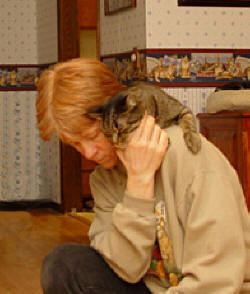
If not for Robbie this website would probably not exist and I might still be feeding my cats a very unhealthy diet of dry food. Robbie is the cute brown tabby that adorns the top of all catinfo.org webpages and who, if given the chance, would spend his life wrapped around my neck.
I call Robbie the “best ‘mistake’ of my life.”
I have had many animals grace my life but my bond with Robbie is one of the deepest I have ever had the privilege to experience. He truly is my furry little soul mate.
Robbie took his first breath at 1 AM on April 6, 2001 when, at the last minute, I decided to do a C-section on his feral mother. I had spayed 6 pregnant cats the day before and was emotionally spent over the death of 27 kittens. I was exhausted at that late hour and it would have been much easier to perform a routine spay on Robbie’s mother but I simply could not take the life of one more living creature.
It is necessary in rescue work to spay pregnant cats. This is a fact of life given the lack of available homes. I had spayed many pregnant cats in the years before Robbie’s birth and I have spayed many more since then but that night a split second decision was made to bring Robbie into the world and he has been my constant companion ever since.
I immediately called my decision a “mistake” because bottle feeding 6 newborns was not an easy task but Robbie has quite literally changed my life so it is a decision I have never regretted.
Ok, so who is Anne Jablonski and how does she figure into the creation of catinfo.org?
Robbie had been dealing with diarrhea for most of his life and being the dutiful vet that I was, I tried every prescription diet available. None of them helped and I now cringe and get angry when looking at the ingredients through much more knowledgeable eyes. Now that I know what it means to be an obligate carnivore with a low thirst drive, I would have to be stranded on a desert island with no other food source to consider putting those diets into a cat’s food bowl.
In December, 2002, at the suggestion of a friend of mine, I joined the Yahoo IBD group out of desperation. Nothing the veterinary community had to offer was helping – including the poor quality prescription diets, steroids, metronidazole, etc.
At the time, I was feeding all of my cats a combination of Hill’s Science Diet Light dry food and Iams Less Active dry food with some NutroMax dry thrown in for variety. No canned food was fed because I came from the ‘old school’ which is full of not-terribly-well-educated people, like myself at the time, who feel that dry food is healthier than canned food.
Unfortunately for our cats, this could not be further from the truth and when humans starts to realize this, we will have fewer sick cats in our world.
Anne was the co-moderator of the IBD group and after a warm welcome, she said in her always-polite delivery……“Um….Dr. Pierson….do you think you might consider feeding your cats a better diet?”
Since I have never had much of an ‘I-am-the-doctor-and-know-better’ type of ego, I listened carefully to what she had to say after replying “Really? Hill’s Science Diet is not a healthy food? But it says right on the label that it is ‘Veterinarian Recommended’!”
Side note: Sadly, many of my colleagues do, indeed, recommend products made by Hill’s (and Purina) and this is a testament to the fact that most veterinarians are not well-versed in proper feline nutrition and simply defer to companies like Hill’s and Purina whose marketing budgets are huge. These large budgets include substantial sums of money dedicated to sponsoring – including very heavy advertising – our professional meetings and infiltrating veterinary schools to get students ‘married’ to their products.
Coincidentally, just after Anne’s comment, I picked up our profession’s most recent Journal of American Veterinary Medical Association (the Dec. 1, 2002 issue) which contained, under Timely Topics in Nutrition, Dr. Debra Zoran’s wonderful article entitled The Carnivore Connection to Nutrition in Cats.
I immediately read it and a light bulb came on over my head.
I went to the cupboard and read the ingredients on the bags of dry food and also noted the low moisture content while keeping in mind that cats have an inherently low thirst drive and are designed to get water with their food.
I cringed.
So, do some cats live long lives on this type of diet? Yes, they do but I am more interested in feeding a diet that promotes thriving and not simply surviving.
I want to feed a diet that gives my cats the best chance of avoiding gastrointestinal disturbances, diabetes, obesity, and urinary tract diseases – including life-threatening and painful urethral blockages and bladder inflammation (cystitis).
One of the most important pages on this website is the Urinary Tract Health page which states:
If I could have the reader of this webpage take away just one word from this discussion, it would be “water“. If your cat is on a properly hydrated diet of 100% canned food – and no dry food – you stand a very good chance of never needing to read this webpage.”
Think of canned food as flushing out your cat’s the bladder several times a day. If the bladder is ‘rinsed out’ frequently, your cat is much less apt to suffer like Opie did as shown below.
A very smart veterinary urologist has stated: “Dilution is the solution to the pollution.” This means that water flowing through the bladder will dilute crystals, protein, mucus, and cellular debris in the bladder. This “pollution” comprises material that could turn into stones/plugs that would block the cat’s urethra.
Please do not make the very common statement: “But my cat drinks a lot of water so I know he is getting enough!”
Cats have a very low thirst drive and it has been shown that they consume approximately double the amount of water when fed canned food (78% water) versus dry food (10% water). This is taking into consideration the water they consume from their food plus the water bowl but please note that cats on canned food rarely drink. This is because they are on a properly hydrated diet and are getting a large amount of water through their food.
This issue becomes clearer when we understand that a cat’s normal prey is ~70% water and they evolved as a desert dwelling species. If prey was available, their extra water needs were minimal.
Opie is a painful example of the suffering often caused by dry food.
He was a stray cat that would have died a very slow, painful, and miserable death if TLC Adoptions had not rescued him in 2008.
 |
 |
 |
 |
 |
 |
 |
 |
 |
There is nothing in bags of cooked-to-death, water-depleted, heavily plant-based protein, high carbohydrate diets that makes any sense to me.
Nothing about dry cat food comes close to resembling the properly-hydrated, low carb, animal protein diet that a cat is designed to eat. When looking at bags of dry food, I see plenty of moisture-deficient species-inappropriate, profit margin-driven ingredients that make the stockholders of pet food companies very happy.
Dry foods are also contaminated with bacteria, storage mites, and dangerous – and life-threatening – mold spores and toxins which make cats sick more often than people realize.
Vomiting and diarrhea are very common feline problems that veterinarians deal with on a daily basis. However, it amazes me how infrequently the food – especially dry food – is looked at as a source of the patient’s illness.
Thanks to Anne and Dr. Zoran’s article, I made a firm commitment on December 22, 2002 to start working toward removing all dry food from my cats’ diet.
Unfortunately, my 7 cats at the time had other ideas. They ranged in age from 1.5 – 10 years and had been fed a 100% dry food diet for their entire lives. I had 7 die-hard kibble addicts on my hands which made for a VERY frustrating next 3 months.
See Tips for Transitioning Dry Food Addicts to Canned Food which emphasizes using patience, time, and tricks to get cats off of all dry food.
By March, 2003, I had won the battle and had gotten all dry food out of my house. My cats had finally found their inner carnivore and were eating a 100% canned food diet. They now had more energy and the overweight ones were slimming down.
And most importantly, Robbie’s diarrhea had vastly improved.
I was happy that my four-legged family was finally eating a water-rich diet with low carbohydrates, and meat (not plants) as their protein source but I was becoming frustrated over the lack of control that I had with respect to the ingredient quality and composition (the caloric distribution between protein, fat, and carbohydrate) of commercial canned foods.
With Anne’s guidance, I started making my own cat food. To be honest, I felt liberated with my newfound control over what was going into my cats’ food bowls and, for the first time in his life, Robbie had formed stools!
Interestingly, my Making Cat Food page is the second most visited page on this site – second only to the Feeding Your Cat: Know the Basics of Feline Nutrition page. I am pleasantly surprised to know that there are so many people willing to make cat food!
 |
 |
 |
Making your cat’s food may sound like a daunting task but if you knew what an idiot I am in the kitchen you would be impressed by just how easy it is.
If I can make cat food, anybody can.
I spend a few hours in the kitchen (my least favorite room in the house) 4-6 times each year making the food which then goes into the freezer. For me, this is a very small amount of time out of my life to ensure that I have complete control over what goes into my cats’ food bowls.
That said, my goal with this site is simply to get people to stop feeding dry food and to switch to canned food. As noted on my Commercial Canned Cat Food page, I would MUCH rather see someone feed the cheapest canned food (Friskies, etc.) than the most expensive dry food.
Why? Because nearly all canned foods address the 3 main issues with feeding cats:
1) They all contain an appropriate amount of water for a species with a low thirst drive – so cats won’t have to suffer like Opie did.
2) Most canned foods are low in carbohydrates (Hill’s products and some Purina products are notable exceptions).
3) The protein is more apt to come from meat and not plants (grains/vegetables).

So, in summary, my love of Austin led me to rescue work which resulted in Robbie entering my life. Robbie’s chronic diarrhea led me to Anne. And because of Anne’s gentle nudging, I began to look at the food I was putting into my best friends’ food bowls with a more critical eye.
And my deep love of cats and keen interest in internal medicine and nutrition led to the creation of catinfo.org.
As my time permits, I will continue to write new articles for this site as well as update current writings.
I’m often asked why I don’t write a book. My reason? We never stop learning and growing. Once something is in print, it cannot be updated – unlike this website.
You will notice that there is a date at the bottom of every page showing when the last revision was written. Keeping the site current is extremely time consuming but I do my best as time permits.
Thanks to all of you and your quest for knowledge, this website has become quite popular with approximately 3 million visitors each year. Many of you have added a link to catinfo.org on your own websites which has resulted in more cats getting fed and cared for optimally.
If you have found your way to this site, your cats are very lucky to have you care deeply enough about their well-being to put the time in to research ways to promote optimal feline health. It is my hope that the information contained here will improve the quality and length of your cat’s life.
Happy reading!
Dr. Pierson and Robbie
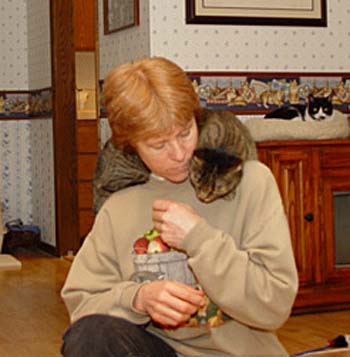
September 2011
May 2025
Lisa A. Pierson, DVM