Lisa A. Pierson, DVM

ATTENTION: 1/7/25 – In light of the current Highly Pathogenic Avian Influenza A (H5N1, “Bird Flu”) infections, which cats have been shown to be highly susceptible to, I am strongly recommending against the feeding of any raw food, especially poultry. Therefore, disregard any mention of the word “raw” contained on this webpage starting with the “original dialog” noted below.
For my own cats, I am fully cooking chicken thighs instead of partially cooking them as discussed in the Safety section at the bottom of this page.
I am following the recipe as is (of course, adding all supplements after the meat has been cooked and cooled) but I am adding in one multivitamin such as Centrum Adult or Nature Made Multi for Adults.
Regarding the feeding of raw rabbit, to the best of my knowledge, there have been no cases of bird flu infections in rabbits but they are definitely not immune to the virus. The feeding raw rabbit does carry some risk but the risk appears to be low at this time. For many years, I fed finely ground raw rabbit from wholefoods4pets.com. If I was still feeding this product to my cats, I would consider cooking it instead of feeding it raw; everyone has to work within their own personal comfort zone.
Please note that there is no danger in cooking ground bones. People erroneously think this is a problem but it is the cooking of whole bones that presents a problem due to the potential for them shattering into sharp pieces.
~~~~~~~~~~~~~~~~~~~~
Original dialog:
To the best of my knowledge, this webpage is the only source of information for striking a balance between cooked and raw homemade cat/kitten food. Every other source focuses on either 100% cooked or 100% raw with individual proponents vehemently arguing which is better/safer.
(A short note regarding dogs can be found at the bottom of this webpage. Also, please consider purchasing Feeding Miss Lilly by my colleague, Dr. Christine King. Dr. King is a fabulous writer and her book is a very enjoyable and easy-to-read essay discussing how she feeds her own beloved dog and why.)
As this webpage explains (see Safety), there is a logical way to compromise between the two which will result in a diet that is safer and healthier than any dry food, and is safer than some sources of raw ingredients – especially those that come from a supermarket and have spent time in a refrigerator versus a freezer.
It is my strong preference to feed a diet that is a safe balance between raw and cooked as described below. This is why I ask my clients/readers to use the word “homemade” as opposed to “raw” when discussing the diet described on this page.
Note that dry kibble is very often contaminated with bacteria, fungal mycotoxins, insects and their feces, as well as being high in carbohydrates and plant-based (vs animal-based) proteins.
And, more importantly, all dry foods are dangerously low in water which wreaks havoc on your cat’s urinary tract and puts him at great risk for life-threatening and excruciatingly painful urethral obstructions and possibly cystitis. (See Urinary Tract Diseases – Opie’s Story.)
If you are firmly opposed to feeding any part of the diet in a raw form – even after reading the Safety section below – you can contact me to set up an appointment for a phone consultation to discuss formulating and preparing a diet that uses cooked ingredients.
For a comment about feeding cats with chronic kidney disease (CKD), please see this note below.
~~~~~~~~~~~~~~~~~~~~~~~~~~~~~~~~~~~~~~~~~~~~~~~~~~~~~~
Table of Contents
You will notice that several statements are repeated in various sections linked below. This is because I am assuming that many people will not read the entire webpage.
Making cat food – quick summary
With bones or without bones; how much bone
Making the food – VIDEO
Commercial pet food contamination – especially dry food
Important Comments
I frequently see people jump into making cat food without doing their homework and without any thought as to using a balanced recipe. This is what gives veterinarians – including myself – a very good reason for recommending against homemade diets.
I recently came across a post within an internet group stating how “wonderful” my Making Cat Food page is – including the recipe provided below. However, the poster then went on to outline what she was feeding to her cat which was not even close to the recipe discussed on this webpage! This poor cat was being fed a terribly UNbalanced diet because his owner was using her own ‘creation’ based very loosely on the recipe below.
She had completely missed the boat on this very critical issue and was harming her cat.
If you are not going to follow a balanced recipe, then please feed a balanced, commercial canned food diet. Please see Feeding Your Cat: Know the Basics of Feline Nutrition for reasons why dry food is not a healthy diet for any cat.
Making cat food: Do it and do it right, or don’t do it at all. It is not difficult to make cat food but do your homework first and do not get ‘creative’ and start adding/omitting ingredients to/from a balanced recipe.
Introduction
After spending a great deal of time reading and learning about the way commercial pet foods are processed, and the ingredients that go into many of these foods, I decided to start making my own cat food. I found that I was getting more and more frustrated with the species-inappropriate and low quality ingredients found in most commercial foods so this was a very easy decision for me to make.
Also, the 2007 Menu pet food tragedy that resulted in the deaths and severely compromised health of many cats and dogs left me with an even deeper desire to have as much control as possible over what goes into my cats’ food bowls. I don’t ever want to go through what those people went through when they lost their beloved pets due to human greed and deception. I remember feeling a great sense of relief knowing that my cats were eating a diet that I had personally sourced and prepared for them – and that feeling continues. I don’t see myself ever going back to feeding commercial cat food after having fed a 100% homemade diet since 2003.
My cats are very special to me and I feel it is important for them to eat a diet that is equal in nutritional quality to what I would put on my own dinner plate. I spend a few hours in the kitchen every ~ 12 – 16 weeks making a batch of food that is then frozen. This is a small amount of time out of my schedule given the rewards.
I have been using the recipe below since early 2003 and I could not be happier with my cats’ health and energy level and – again – my control over their diet.
If you decide that making cat food is not for you, then please at least feed canned food and no dry food.
Raw vs Cooked
This subject is one of considerable debate among two – usually strongly divided – mindsets.
The anti-raw folks are afraid of bacteria and parasites.
The pro-raw feeders are afraid of nutrient loss from cooking/processing.
However, it is not necessary to have such an ‘all or nothing’ viewpoint and our cats will benefit if people approach this issue with more critical thought and compromise.
Unfortunately, often neither group considers how the meat is sourced and prepared and they fail to see that one can strike a balance between the two issues.
Our goal is to feed a diet that nature intended for our carnivores – staying as close as possible to the form and nutritional composition that our cats would eat in a natural setting – while implementing safety strategies as discussed below.
I am not as smart as nature. No human is – even board-certified veterinary nutritionists. None of us know exactly which nutrients and in what amounts are destroyed/damaged with the cooking process.
Because of this fact, I choose to ‘split the difference’ between semi-cooked and 100% raw depending on the source of the meat.
I feed meat from two sources:
- Rabbit obtained directly from a rabbit producer (wholefoods4pets.com) – fed 100% raw. Hare Today, Gone Tomorrow on the east coast is another option.
- Chicken and turkey whole thighs (never pre-ground) from the supermarket – fed partially baked to kill surface bacteria as discussed in the Safety section below. I never feed poultry from any source in the raw form since it is more apt to be contaminated with harmful bacteria.
If someone wants to buy pre-ground poultry from any source, then they should fully cook it.
In Jauary 2019, the FDA found Salmonella and Listeria in ground chicken/bones/organs from Hare Today, Gone Tomorrow. We know that the FDA allows a baseline percentage of chicken to leave the producer contaminated with Salmonella but keep in mind that the FDA also warns the consumer of the meat (humans) to fully cook it before eating it.
The FDA also tested the ground rabbit from HTGT and no pathogens were found.
With regard to parasites, commercially raised meat (either from the grocery store or producer) is much less apt to be infected with parasites when compared to wild game.
However, meat from a grocery store can be higher in bacteria than meat from a fresh kill in the wild or meat purchased directly from the producer.
But having said that, when considering the issue of bacteria, I am reminded of the mountain lion that ate off of a deer carcass in my brother’s backyard for one week in northern California (not a very cold location…therefore, more bacterial growth). The mountain lion was dining on meat that was a week old in the ambient temperature (not refrigerated) and did just fine.
For the first ~7 years of feeding a homemade diet, I purchased chicken or turkey thighs and simply rinsed them very well with water before grinding them. However, I have since decided to increase the safety of the diet and I now partially baking whole thighs to kill the surface bacteria.
This partial baking makes the diet much safer than dry food.
The main reasons for the switch were:
- I wanted to be able to leave the food out longer.
- I was tired of calling my butcher to see when the poultry thighs were going to be delivered so that I could source them as fresh as possible. Now, I purchase the thighs when it is convenient for me.
The chicken or turkey cat food that I make usually ends up being ~50% cooked and ~50% raw but you should aim for at least a 10-20% surface cook.
The rabbit that I source directly from the producer is fed raw because it is frozen as soon as it is processed and arrives on my doorstep frozen. It is never in a refrigerated state. Refrigeration slows bacterial growth but does not halt it.
For more details, please see my safety section below.
It is up to the reader to work within their comfort zone when deciding whether to go forward with this type of diet, or not. Most things in life do have some risk associated with them but most people think that commercial diets are completely without risk and this could not be further from the truth.
With the critical thought that I put into my cats’ diet with regard to sourcing and preparation, I would confidently submit their diet to a ‘safety contest’ with any dry food on the market.
Dry food (aka “kibble”), in addition to containing potentially deadly fungal toxins, contains a great deal of bacteria.
If you would like to read more comments regarding pet food recalls and the issues with commercial pet food contamination – especially dry food – see below.
Fortunately, our cats’ intestinal tract is designed to handle a much higher bacteria load than that of a human, but if one is worried about the bacteria in raw meat, then the bacteria in dry food also needs to be taken into consideration because dry food is very far from bacteria-free.
Cost
The cost of a homemade diet is extremely variable and takes into consideration:
- the type of meat being used (chicken is a lot cheaper than rabbit),
- where it is sourced (Whole Foods Market is going to be more expensive than a local farm), and
- their cat’s appetite/caloric needs.
The cost of the supplements may seem high when first purchasing them but when averaged over time, the expense is minimal.
A reader of this webpage contacted me regarding a coupon program at iherb.com (which is where I buy my supplements) that allows for $5 off your first purchase if you enter the following code: LIS675 or just click on this link which will take you to the main webpage where the discount will be automatically applied.
See the Recipe section below for links to specific ingredients that I order from iherb.com.
The links are affiliate links which sends a bit of money my way when they are used. I then pass the funds on to charity – specifically, cat rescue efforts focusing on spaying and neutering to help prevent the suffering of homeless cats and kittens.
It would not take much time for the reader to do their individual cost analysis based on the meat they choose to use and their source. For the calculation, I would consider the cost of approximately 5 ounces (weighed raw) of poultry or rabbit (including the bones) + 0.25 ounces (weighed raw) of poultry liver per cat, per day.
Example (consider that there are 16 ounces/lb):
If you can buy chicken thighs at $2.00/lb => 5/16 x $2.00 = $0.63 (63 cents)
If the liver costs $2.00/lb => 0.25/16 x $2.00 = $0.03 (3 cents)
Total = $0.66 (66 cents) per day for one cat
The supplements will add in a bit more but, again, when the cost is averaged over time, it is not that significant.
A discussion regarding the cost of good nutrition would not be complete without considering the cost of not feeding a species-appropriate, nutritious diet. The saying “pay me now or pay me later” really applies here. You can feed your cats well – either with a homemade diet or canned food – or you can pay the veterinarian later. I have often said that if people would feed their cats and dogs better, more vets would be out playing golf.
One must also consider the cost of time involved when dealing with a sick pet.
For instance, diabetes can be a time-consuming and expensive nightmare to deal with. Inflammatory bowel disease is not much fun either, nor are skin allergies to inappropriate ingredients found in most commercial pet food. I would rather spend time making cat food than giving my cat insulin or cleaning up vomit or diarrhea from intestinal woes or dealing with any number of other diet-related problems that keep veterinarians’ waiting rooms full of sick pets.
This is not to say that all feline diseases are necessarily linked to diet but many of them are. “We are what we eat” is not just a useless cliché.
Back to the cost of the food…..
As noted above, I feed meat from two different sources:
- chicken or turkey thighs from Whole Foods Market or another local grocery store; some people get poultry thighs from Costco
- rabbit from wholefoods4pets.com
Poultry thighs:
I buy free-range (whatever that really means given that this issue is poorly regulated), antibiotic-free (as required by law) chicken or turkey thighs (with skin and bone). Some cats like turkey better than chicken. Turkey seems to have a stronger smell than chicken which entices some cats.
I now buy organic chicken (organic turkey is not available in my area) because I only have one cat but when I was feeding a larger herd it was too expensive to buy organic meat.
Rabbit:
The second type of meat that I feed is rabbit and it is shipped to me from Washington – wholefoods4pets.com. I buy 51 lbs at a time of the Extra Fine Double Ground (the most expensive choice) in the 3 lbs packages.
I purchase the Extra Fine Double Ground because my cats were having problems with the bones in the more coarsely ground product. On rare occasions (a few times a year) they would paw violently at their mouths as if a bone was stuck in their gum tissue.
That said, many people feed coarse ground food without any problems. In fact, I have never received a single email from any of my readers saying that their cat had problems with the coarser grind which is much less expensive.
Another option is to buy the less expensive coarse-ground and re-grind it yourself using the 4 mm plate that I show under the Safety section below. Or, just feed it as is.
Grinder:
For the first 10 years of making cat food, I used a Tasin TS-108 meat grinder (a #12 grinder, ~$160) but it finally died in July of 2012 after years of faithful service grinding approximately 45 lbs of meat and bones each month. What a truly impressive workhorse it was! I never expected it to last as long at it did given the amount of food that I grind.
So, what did I decide to replace it with? As much as I loved my Tasin, I had been dreaming of upgrading to a faster and quieter grinder so I went with the Weston #12 Meat Grinder (~$460). I figured that after spending 10 years making cat food, I deserved an upgrade and I have been thrilled with my decision. Yes it is more expensive than the Tasin but, for me, it has been worth every penny.
August 2022 update: I have been using the Weston #12 for 10 years and am still extremely pleased with the it. I will note that in 2016, the Weston #12 was upgraded with 30% more power.
That said, the purchaser must know that the Weston #12 is not warranted for use with bones – only the #22 and #32 are technically warranted for grinding bones. However, many people, including myself have been using the older (‘weaker’) version to grind chicken thigh bones (and turkey thigh bones, on occasion) without any problems so I assume that the newer (as of 2016), more powerful, version will be even better.
All of the above said about the Weston #12…. I want to make it clear that the Tasin TS-108 will be just fine for the average household.
Anne (catnutrition.org ) has been using hers for ~13 years to make food for 2 cats. However, if you are interested in a faster and quieter grinder, I suggest that you consider the Weston #12. Honestly, I am kicking myself for not upgrading sooner.
If you are interested in the smaller Weston #8, understand that it has a smaller feed tube and it is going to be slower than either the Tasin TS-108 (which is a #12 size) or the Weston #12.
April 2017 update: I just consulted with a client who bought a Kitchner Heavy Duty grinder and said that it worked great with chicken thigh bones so that is another option but keep in mind that this is only one report from one person (other than the current 8 positive reviews on Amazon who did *not* mentions grinding bones).
The Tasin has been around longer and has a good track record of happy customers. However, maybe the Kitchner Heavy Duty grinder will turn out to be as good.
Here are two grinders that I would *not* recommend:
1) Kitchner #12 Electric Meat Grinder – 1/2 HP.
2) STX Turbo Force 3000 This grinder has received some good reviews on Amazon.com but I have heard from three people who are very upset with this grinder stating that it does not grind bones well and does not even grind meat efficiently unless it is frozen. Therefore, I cannot recommend purchasing this product.
Here are some comments regarding the Weston #12, along with comparisons to the Tasin meat grinder:
Positives:
- It is very quiet! The Tasin is quite noisy and frankly, it was getting on my nerves. (Now that I have the Weston, Robbie stays in the kitchen with me. Before, he would leave the room when he sensed that I was going to turn the grinder on.)
It is faster – maybe twice as fast as the Tasin TS-108. Making cat food is definitely not my favorite pastime and the sooner I can get out of the kitchen, the happier I am.
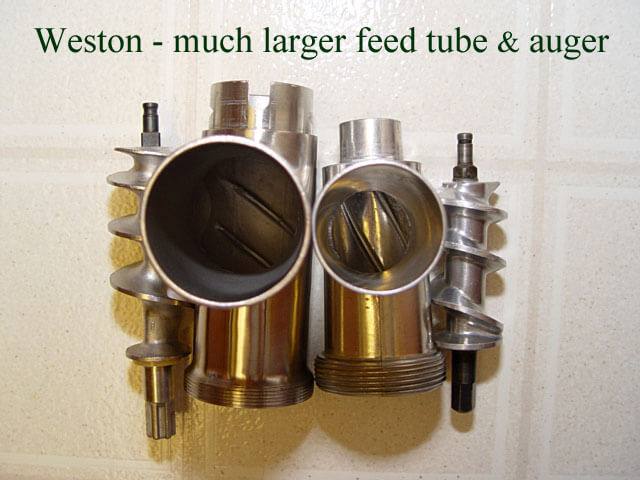
It has a larger feeding tube (2.5″ vs 2.0″) which easily takes a whole chicken thigh but will also accommodate a whole turkey thigh so that means less prep time cutting up meat. The Tasin TS-108 can handle whole pieces of chicken but sometimes a larger thigh needs to be cut down into smaller pieces to fit down the tube. This is not a big deal but is an extra step.
- The Weston’s auger is larger – with a wider ‘bite’ which quickly takes a chicken or turkey thigh bone. This is a significant improvement over the Tasin which sometimes has trouble ‘biting’ the big end (knee joint) of a chicken thigh bone. (It is always best to put the hip joint end in first because it is smaller.)
When I used my Tasin to grind turkey thigh bones (which I do *not* recommend doing), it really labored even when putting the smaller hip joint in first. In an effort to not tax the motor, I did not allow the knee joint to go through the grinder. I would stop the grinder and then back it up to remove the knee joint. This is hard on the motor and probably contributed to my Tasin’s final demise.
While my grinder did process ~100 pounds of turkey thighs, I honestly think that this is expecting a lot from a grinder at this price point. If you must use your Tasin meat grinder for turkey thighs, I would recommend chopping or smashing the bones into smaller pieces to take some of the strain off the motor. For me, this would have been far too much trouble and I would have just stuck with chicken.
- The pan is significantly larger and deeper.
- I can use all of my old grinding plates on the Weston #12. I use the 4 mm plate that came with the Tasin. The Weston comes with a 4.5 mm plate which is close enough.
Negatives:
- The Weston is larger and heavier than the Tasin but I do not have a problem with lifting it onto my sink.
Weston #12 (body only – OLD style, not the new 2016 model): 33.0 lbs (the website states that the new one weighs 45 lbs but I assume that includes the body, the pan, the augar, etc…which you don’t have to lift all at once.)
Dimensions: 14 1/8″ long x 6 1/2″ wide x 11 7/8″ tall
Tasin TS-108 (body only): 8.75 lbs
Dimensions: 12 7/8″ long x 6 1/5″ wide x 9 5/8″ tall
- The Weston does not have a reverse switch which does worry me in case it gets jammed. I used the reverse function on my Tasin (rarely) but my hope is that the Weston’s power will prevent it from jamming so that I will not miss this feature. If it does jam, it won’t be the end of the world; I will just have to take it apart and clean it out. (April 2017 update: I have not experienced any need for the reverse switch.)
Do not get caught up in looking at just the wattage rating since more wattage does not always mean a better or faster grinder. For instance the Tasin TS-108 is listed as a 1,200 watt grinder and the Weston #12 is listed at ¾ HP (2016 now 1 HP) or 560 watts (2016 now 750watts). The motor type and gear construction are significant factors in the performance of the grinder and its power rating.
 |  |
 |  |
Please note that the Tasin and Weston grinder parts (as well as the Turbo Force brand mentioned below) are NOT meant to go into the dishwasher. I don’t have a problem with this since I prefer to wash them by hand anyway. The grinding plates are not stainless steel but I have never had any problems with rust forming. I simply wash them off with soap and hot water (using a nail to clean out any clogged holes) and then dry them and wrap them in a paper towel to wick away any moisture. I have never needed to add any oil to them.
However, some people spray the grinding plates with food grade silicone spray before storing them. This will help prevent rusting.
~~~~~~~~~~~~~~~~~~~~~~~~~~~~~~~~~~~~~~~~~~~~~~

Before you dive into making cat food….
…..I want to mention that there are few things more frustrating than slaving away in the kitchen carefully preparing a wonderful meal for your carnivore…..only to have them end up sniffing it and then walking away.
I don’t like to see people get discouraged so I strongly suggest that you just take it slowly.
When I decided to start making cat food, I did not buy a grinder and all of the supplements right away. I just simply bought a chicken thigh, thoroughly rinsed the meat with water, and cut it up into small pieces (the size of a pea or a bit larger) to see if my cats would eat raw meat. A couple of cats went for it right away and a couple of them just walked away.
Ok….that was a start.
(Most cats will like thigh meat better than breast meat because thigh meat has a higher fat content and fat increases palatability.)
I then mixed in a few of these small pieces with their canned food to get them used to the taste and texture of just plain meat. I also cooked some of the pieces to see how that went over. If your cat likes it cooked, you can then cook it less and less to get them used to eating raw or semi-cooked meat.
Other tips: Coat the meat pieces in parmesan cheese or FortiFlora. FortiFlora is a probiotic that I use to entice cats to eat. I do not use it as the label states since I am not using it for its probiotic properties. Instead, I am using it as I would if I wanted to season my own food with salt and pepper. As little as 1/10th or 1/20th of a package sprinkled on top of food can go a long way to entice a cat to eat something new. This is because FortiFlora is formulated using animal digest which is the same substance that pet food manufacturers coat dry food with to make it very palatable for cats and dogs.
FortiFlora has an expiration date on it which I don’t pay any attention to since I am not using it for its probiotic properties. Therefore, I don’t care if the ‘good’ bacteria in the product are dead or not. I am only using the product because most cats really like the taste of it. I think that all cat owners should have it in their cupboard in the event that you want your cat to try something new or they are ill and not wanting to eat anything. A box of it may very well last you a lifetime.
If you have been feeding your cat dry food, try crushing the dry food in a baggie and then rolling the meat pieces in it. You can also use crushed Temptations treats, etc. Temptations treats are easier to source and are cheaper than a box of FortiFlora and may work just as well.
I experimented in various ways as stated above for a couple of weeks before I bought a grinder and the supplements. Much to my surprise, several of my cats actually immediately preferred what I made for them over the commercial canned food that they were eating. To this day, several of my cats will not even eat canned food anymore – they will only eat their homemade diet. I have created little obligate carnivore monsters who hold out for their species-appropriate diet.
Another option before purchasing the grinder and supplements is to try a commercially prepared raw food. That said, I do not favor the use of commercial raw diets long-term (more than a couple of weeks to see if the cat will eat this type of diet) mainly because many of them have too much bone material relative to the meat. Please see my comments regarding commercial raw diets at the bottom of my Commercial Food page.
A second option is to purchase one of the TCfeline premix powders from the Raw Meat Cat Food Company (formerly Feline Future). Note that there are different pre-mixes depending on if you want to add fresh liver along with the fresh meat (preferable) in which case you would use the TCfeline Original powder or, if you do not want to use fresh liver, you can use the TCfeline Plus with chicken liver.
Please note that I prefer chicken liver over beef liver. I do not recommend the use of their “Special” formulation. I prefer to formulate diets for my kidney disease-patients on an individual basis. Keep in mind that it was a very sad day when humans deemed that protein is an enemy of the cat – including patients with chronic kidney disease. It is not necessary to add vegetables (or grains) to a cat’s diet to lower the protein.
The TCfeline pre-mix powder is to be mixed with water, ground meat and skin (no bones), and liver unless using the Plus version.
Please be aware, however, that I am not advising to use pre-ground meat in the raw form due to safety issues so you will still have to find a way to grind up whole, boneless cuts of meat. Food processors work well for meat but not bones, or skin. That said, I find them much harder to clean than a meat grinder and would never use one for making cat food.
Please see the Safety Issues below for more information on pre-ground meat. If you want to use the TCfeline pre-mix powder, then I would suggest buying chicken or turkey thighs (with the bone and skin) and baking as discussed in the Safety section below. After removing the thighs from the oven, debone them. After deboning the thighs, run the meat and skin through a food processor or grinder. I discuss how much skin to use in the Ingredient section below.
I would also like to mention that the recipe on this page is adapted from earlier work done by Natascha Wille of Feline Future Raw Meat Cat Food Company. I am very grateful to Natascha for her pioneering work in this area.
However, I did notice one statement on the Feline Future (now Raw Meat Cat Food Company) webpage that I need to address. I would not let a cat go without food for 48 hours when trying to get them to switch to a new diet. There is no reason to be that extreme. Time and patience is the key – not starvation. I will let a healthy cat go without food for about 18 hours and then offer them some of their regular food if they will not eat the new food that you are introducing. See Tips for Transitioning.
Please keep in mind that many cats are not going to dive into any new food right away! It takes time, patience, and some tricks to transition cats onto a new diet. (It took me 3 months to get my cats off of dry food and eating canned food but it took less time to move them from canned to homemade.)
Also note that I have seen cats go from dry food to a raw or semi-cooked diet – and still refuse to eat canned food.
If your cat does not take to a new food immediately, don’t get discouraged. Try mixing the new food with their existing diet of canned food at a ratio of 10% new to 90% old and then gradually increase the new diet from there.
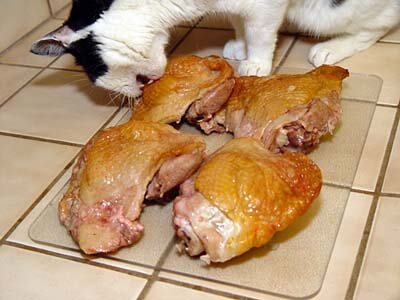
Your cat may make it easy for you and show enthusiasm for the new food right away….but many (most?) will not. It took one of my cats (Toby) many months before he would start eating this diet with any consistency and when he finally did start eating it, I noticed that he was picking out the pieces that got a bit cooked when I was warming the food. Toby still is not terribly keen on strictly raw meat so he gets his semi-cooked. See below for a picture of how he likes his homemade diet half cooked and half raw. I often cook it even more than is shown in the picture below. Interestingly, Toby is one of my cats that does not like canned food.
Some people feed a bit of canned mixed with the homemade for the rest of the cat’s life. I don’t have a problem with this if that is what it takes to get them to eat a predominantly homemade diet.
My mom’s cat, Tyke, has drawn his ‘line in the sand’ and will only eat his homemade diet when it is 2/3 homemade and 1/3 Sheba. He is 19.5 years old so….we compromise.
Making Cat Food – Quick Summary
Making cat food is not difficult. I am a walking disaster in the kitchen and it is my least favorite room in the house. If I can make cat food, anybody can. I won’t lie – it can be a bit time-consuming – but it is definitely not difficult or complicated. If you can follow a simple recipe, you can make cat food. I usually prepare enough food for 3-4 months at a time but I have also used food that has been in my freezer for up to 1 year.
I was afraid that the 1 year old food would be freezer burned but I rinsed the top ice crystals off and my cats were fine with it. And…they are normally very picky cats.
All that said, aim for no more than 4 months in the freezer since nutrients do degrade over time – even when in the freezer.
The time that I spend making cat food is much less time than is involved in caring for cats that become ill from poor nutrition.
In a nutshell – before I go into more detail below – I grind up meat, bones, skin, and liver. I then make a supplement slurry by adding vitamin B-complex, vitamin E, fish oil, taurine, and iodized lite salt (if using poultry thighs) to water.
After I am sure that all of the supplements are thoroughly dissolved in the water, I mix the slurry into the ground up meat/skin/liver and then portion it into containers and put it in the freezer.
Very simple.
If I was not so lazy, I would use the eggs that are listed in the recipe below. Truth be told, I have not added eggs to the recipe for many years so I will leave that open as an option. If you can swing it – add them. They are very nutritious – especially the yolks.
I also cut some of the meat into chunks for dental health – when I am not being lazy.
Of course your cat has to have a healthy mouth to start off with when pushing the chewing issue. No cat will want to chew on any type of food if he has a painful mouth!
See the Dental Health section below.
The picture of the ground thighs shown below was taken when I was just rinsing the thighs off in water – versus baking as mentioned above. Therefore, the meat below appears to be a deeper color of red that it will if you partially bake the meat.
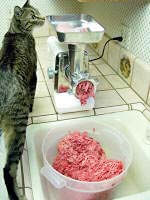

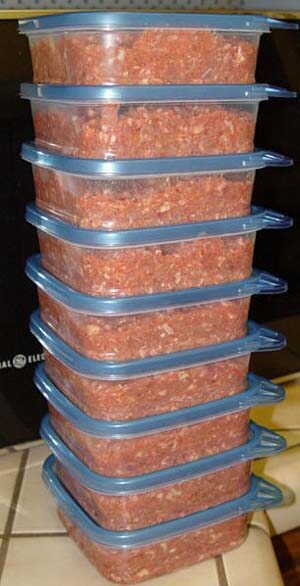
Please also see a very helpful pictorial section on Anne Jablonski’s website at catnutrition.org.
In addition to the great pictures that Anne has on her website, she also has a frequently-asked-questions list that address many of the issues that come up when people are new to making cat food.
Also, if you are interested in learning more about feline nutrition, please read Michelle Bernard’s book Raising Cats Naturally.
I tend to be a bit lazier than Anne so the information here will differ from her way of doing things just a bit. I will point out where I deviate from her methods and then you can decide for yourself how you would like to proceed.
With Bones….or Without Bones…and How Much Bone to Use?
One of the most important issues to address when feeding a homemade diet is the calcium-to-phosphorus ratio. Keep in mind: Bones = calcium (etc.)…..Meat = phosphorus.
When a cat eats a bird or a mouse, he is getting a naturally balanced diet since he is eating both meat and bones.
Always remember that calcium is not an optional ‘supplement’ but a very critical component of the diet.
The bones must be ground with the meat (preferable), or another source of calcium + additional supplements must be added to the recipe if only meat is used. A cat cannot live on meat alone with no source of calcium.
Meat is high in phosphorus but does not contain much calcium. Therefore, a calcium source must be supplied and it must be done in the proper ratio considering the phosphorus in the meat. The most obvious – and best – way to add calcium to the recipe is to grind the bones with the meat.
I am a stickler for using fresh bone versus bone meal or calcium carbonate. You will not find a substitute source of calcium (bone meal, egg shells, etc.) that has all of the elements that are contained in fresh bone. Bone meal is heavily processed and the nutrients in the marrow will not survive the processing intact.
Plus, it is so easy to just grind the meat and bones together. And….deboning meat is not much fun and I do not advocate the feeding of pre-ground supermarket meat fed in the raw form. The bacterial load can put your cat at risk for severe illness.
September, 2011 update: For people who are unwilling or unable to purchase a grinder, I have finally ‘given in’ and added to the recipe section below the amount of bone meal needed to balance a boneless diet. However, you will still need a food processor to grind up the meat, skin, liver, and eggs since, again, I do not advocate using pre-ground supermarket meat. You will also have to debone whole cuts of meat such as chicken or turkey thighs. (In the long run, most people come to realize that it is much easier to just use a grinder.)
Back to bone…..how much to use…..
When the typical prey of wild cats is analyzed, we see that there is a fairly wide range in the calcium-to-phosphorus ratio in these prey animals so we do have some leeway when dealing with this issue.
Note that when small wild cats eat mice and small rabbits they usually eat the entire carcass – including the entire boney skeleton of their prey – whereas the larger cats (lions, etc.) strip the meat off of the bones leaving much of the skeletal structure of their prey behind. This fact illustrates that there is a wide variation in how much bone material wild cats consume.
Taking a logical look at the calcium-to-phosphorus ratio (bone-to-meat ratio), it would seem that the easiest way to ensure having a proper ratio is to use a whole carcass of whatever animal you are choosing as a food source. However, after witnessing constipation in many raw-fed cats, as well as life-threatening urethral obstructions (see Anne’s Sidney Beans’ story here and Opie’s story here), and watching lions strip the meat from the bones – leaving most of the bones behind – I am not comfortable feeding as much bone as that found in whole chickens, turkeys, or rabbits.
Therefore, I use poultry thighs, which have a lot of meat relative to the bone. I dilute the bone even further by removing ~30% of the thigh bones. If I am grinding 10 thighs, I remove 3 bones.
I also add boneless poultry meat (including some of the fat and skin) to the whole carcass ground rabbit for the following reasons:
- Rabbit has a high bone-to-meat ratio and I want to dilute out that bone with some poultry meat/skin.
- Rabbit is a very low-fat meat. Plus, it is skinned prior to grinding which reduces the fat content even further. Fat is an important component of a carnivore’s diet. Therefore, I want to add some fat/skin to the rabbit diet and using poultry is the easiest way to do this.
- I can cut part – or all – of the poultry meat into chunks to help promote dental health.
- Adding in some poultry lowers the price of the food since poultry is cheaper than rabbit.
If you choose to grind up an entire carcass and not dilute the bone with added boneless meat, then I would suggest at least leaving out the back and neck since these are the parts of the chicken/turkey with the highest bone-to-meat ratio.
On a good note, if you do choose to grind up whole poultry carcasses, in considering the bone-to-meat ratio, our commercially raised chickens and turkeys will most likely have a lower bone-to-meat (higher meat-to-bone) ratio than a wild chicken/turkey given that poultry producers do whatever they can to promote ‘meaty’ birds for human consumption.
But all that said, unless you are trying to save money by using whole carcasses, I suggest just using poultry thighs which will lower the bone content of the food since the thigh is the meatiest part of a bird’s body that contains a bone. Also, cutting up carcasses is not only an unpleasant task but it is also very time-consuming.
Constipation
Updated 6/1/14 with added poop pictures for your viewing pleasure.
If you are tempted to write to me about your cat’s constipation (or diarrhea) issues, please understand that no advice will ever be offered via email.
A consultation (via phone or Skype) can be scheduled but only after medical records – including lab work and your veterinarian’s physical exam/diagnosis/recommendations/treatment notes – are provided for my review.
~~~~~~~~~~~~~~~~~~~~~~~~~~~~~~~~~~
Many people write to me stating that their cat is “constipated” simply because they are not passing feces every day. However, this is not necessarily a sign of constipation. Cats on a low residue (low fiber/low waste/highly digestible) diet will often not pass stool every day.
There is very little non-digestible matter contained in this diet. Therefore, the volume of feces will often be much less when compared to cats on high fiber or poorly digestible diets.
Signs of constipation can include:
- straining without production of feces,
- crying in the litter box and acting distressed,
- diarrhea – yes, you read that correctly – sometimes diarrhea feces will leak around a hard piece of stool,
- excessive licking of the anal area, and
- defecating outside of the litter box can also be a sign of constipation but it can also be due to other (behavioral and/or medical) issues. These cats either associate the litter box with pain and develop a litter box aversion or they simply get discouraged and impatient when trying to defecate in the litter box and end up going elsewhere.
Make sure that you are not confusing constipation with urethral obstruction! A cat with a blocked urethra – which blocks urination – is in a tremendous amount of pain and their bladder can rupture, resulting in death within 24 hours. Seek immediate veterinary attention if your cat is not able to pass urine.
Note: Some cats – especially long-haired cats – end up with ‘hang on’ poop meaning that the bulk of the feces was passed but a long thread of hair is mixed in with the feces with one end still in the rectum resulting in the feces hanging from the anus. In these cases you may see poop outside of the litter box – wherever the poor cat managed to get the ‘hang’er on’er’ off – but this is not an issue of constipation. In these cases, look for a stringy tapered end to the fecal ‘log.’
If your cat is exhibiting any of the signs of constipation noted above, it is important to determine if he has any other medical problem(s) that may be causing or contributing to the constipation. For instance, kidney disease can cause dehydration which, in turn, can lead to constipation.
Intestinal disease is also common in cats and constipation can be a sign of an unhealthy intestinal tract.
The two treatments that will be discussed in this section are Miralax (or its generic equivalent) and soluble fiber (e.g., guar gum, pumpkin, and psyllium).
- Miralax increases fecal water content without increasing bulk/diameter. It is a laxative (made for humans) that can be found at pharmacies and some grocery stores.
- Soluble fiber increases fecal water content but also increases bulk. Soluble fiber (versus insoluble fiber) may also play a beneficial role in intestinal health since it is fermented to short chain fatty acids which nourish the cells of the colon and also promote healthy bacteria.
Both treatments can be used at the same time but I normally just start with Miralax. The dosage of each is determined on a case-by-case basis but I will discuss general starting doses below.
~~~~~~~~~~~~~~~~~~~~~~~~~~~~~~~~~~
What is the normal consistency of feline feces when eating a species-appropriate diet?
With regard to the diet discussed on this webpage, as well as some low residue commercial canned and commercial raw diets, it is important to note that the feces of a cat eating a species-appropriate diet are often dry and crumbly which is not necessarily abnormal, or a problem, for most cats.
Cats eating a natural, species-appropriate diet do not produce soft, voluminous, stinky feces like so many people are used to seeing from their cats eating commercial diets.
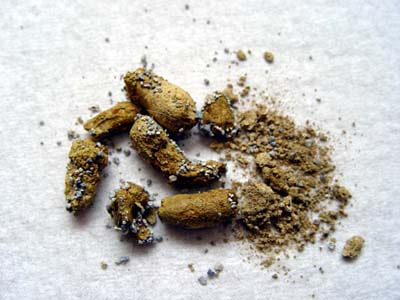
This is a picture of feces from 2 separate bowel movements from my cats. In other words, an average bowel movement from my cats is half this volume – or even less. I crushed 2 of the fecal pieces to show how dry and crumbly it is. The feces from my cats also has very little odor.
That said, some cats do experience constipation when started on a species-appropriate diet (homemade, commercial raw, or canned) and it needs to be addressed.
The reason(s) for the constipation may be different for each cat but one cause may be the addition of too much bone to the diet.
Note that when I use chicken thighs, I remove ~30% of the bones.
Wings, necks and backs are all parts of the chicken with a very high bone-to-meat ratio. These parts of the chicken should never be used as the sole component of the diet. I suspect that these body parts make up a large percentage of some of the commercial raw diets since they are cheap and are part of the ‘discards’ from the human-targeted market.
Another reason that cats may experience constipation from this type of diet is because the fecal ‘logs’ are smaller in diameter than those produced from higher residue commercial diets and the cat’s gut tract is not accustomed to dealing with the difference in bulk.
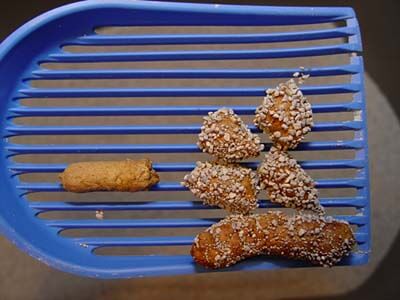
Right: Feces produced from a canned food diet
Take my word for it….the one on the left = very little odor
The one on the right = very stinky (fiber is fermented into some very smelly gases)
Notice the larger diameter of the feces on the right.
The normal body is stimulated to defecate when the colon is distended/full. While the feces on the left is not abnormal and is very easily passed by most cats, some cats’ colon may not be ‘triggered’ with only mild distension after spending years exposed to diets that produce bulkier feces.
The longer the feces sit in the colon, the more water is pulled from it (since the colon’s job is to save water for the body) and the drier the feces become, leading to constipation in some cats.
There are two main issues to consider:
- fecal water content – is it too dry – for the specific patient? Take a paper towel and squeeze the poop. Is it firm? Soft? Dry and crumbly?
- fecal diameter – is it too skinny, possibly not triggering defecation in some cats?
It is important to determine the answers to the above questions because constipation is not a ‘one treatment fits all‘ situation.
Treating constipation involves trial and error and the condition often benefits from a combination of treatments as discussed further below.
Generally speaking, all constipated cats will benefit from an increase in fecal water content but the main question is: Do we want to increase fecal bulk (increase in diameter) with a soluble fiber?
In most cases, we don’t want to do that – at least not significantly. However, as noted above, there is evidence to show that soluble fiber (a bulking agent) has other beneficial effects on the colon.
Therefore, I occasionally add a small amount of soluble fiber into the diet, in addition to using Miralax for some constipated patients.
In the ‘old days,’ megacolon cats (cats with abnormally large colons with compromised motility) were routinely treated with high fiber diets. Unfortunately, many of these cats had their constipation worsen because their compromised colon could not handle the bulky stool.
But as the saying goes, “the devil is in the details” or, in this case, the dosage. While too much fiber (or the wrong type of fiber – INsoluble vs soluble) may be detrimental, a lower dosage of the correct type of fiber (soluble) may be beneficial. This is true for megacolon cases as well as the average cat with a reasonably healthy gut tract experiencing a bout of constipation.
When treating constipation in cats, monitor the diameter of the feces, as well as the moisture content to determine which treatment – and dosage – works best for your cat.
To repeat: We are not looking to create a large, soft, stinky poop by using too much fiber!
Visual example:
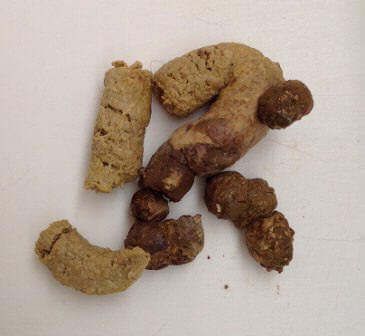
I recently added a bit of guar gum (soluble fiber) to my cats’ food. Note that the first part of the stool (the dark part) is fiber-free and is firm and dry – just like what would be found coming out of a wild cat eating a natural diet.
The firm stool is followed by the guar gum stool which is ~3/4″ – 7/8″ in diameter and is very soft. This is not what we want for the average cat.
Starting dosages for Miralax and soluble fiber:
- Miralax (or its generic equivalent): Again, it increases fecal water content without adding bulk to the stool. Most feline veterinary practitioners like using Miralax much better than lactulose which also adds water but not bulk. Miralax is tasteless and can be mixed with the food. This is much better than trying to get sweet, sticky lactulose into a cat!
Start with 1/16 to 1/8 tsp once or twice-daily mixed into the food and increase from there to get the desired fecal consistency. I usually start with 1/16 tsp in the first few meals to make sure that they eat it. Most cats do well on no more than 1/4 tsp twice-daily but it is safe to go higher. If your cat’s stools are too loose, lower the dosage.
- Soluble fiber such as guar gum: Start with 1/16 tsp once or twice-daily (use one half of a 1/8 tsp measuring spoon) – add extra water (1-2 tablespoons) to the meal or an amount just short of your cat refusing to eat the food. Fiber absorbs water like a sponge and then swells thereby adding bulk to the feces. Therefore, we want to add extra water to the food.
You can purchase guar gum from Whole Foods Market or online here.
Many people use pumpkin (canned – plain….not pumpkin pie filling with added sugar and spices) but some cats do not like it. I prefer guar gum because it is more convenient and is not an unnecessary source of carbohydrates for our carnivores. It lasts forever (it is not perishable) and most cats readily eat it when mixed into their food. If you want to try pumpkin, use 1/2 – 1 teaspoon 2-3 times per day mixed into their food. Some people freeze the pumpkin in ice cube trays for convenience.
Psyllium husk powder is also an option. Start with 1/4 tsp once or twice daily and increase or decrease from there as needed.
All of the above treatments are ‘dosed to desired effect.’
To repeat: The “effects” being monitored are:
- relief from clinical signs of constipation
- fecal water content
- fecal diameter
Keep in mind that cats are not designed to handle a lot of fiber in their intestinal tract. The diet of a wild cat is very low in fiber. Horses and cows, on the other hand, are designed to eat very high fiber diets.
It is ok to add a little fiber to your cat’s food but we don’t want his poop looking like it came out of a St. Bernard!
There is one drawback to using fiber….you will no longer be able to brag that your cat’s poop does not have any odor. The feces of a cat fed the recipe discussed on this webpage (without fiber) has very little odor but soluble fiber is fermented into some pretty stinky gases by the bacteria in the colon.
Meat Types and Sources
As discussed above, I use chicken, turkey, and rabbit.
- The poultry is purchased from Whole Foods Market and is antibiotic-free (as per the law) but is not organic due to the cost. I use chicken or turkey thighs with bone and skin.
I also purchase chicken livers at WFM or another local grocery store.
- The rabbit is sourced from wholefoods4pets.com and I purchase the extra fine double ground product. This product, which includes the meat, bones and organs (skin/hair/stomach/intestines are removed), arrives frozen in 3 lbs flat bags which are easy to store in the freezer.
This product does not have to be re-ground.
Note that each rabbit comes with its own liver (and other organs) so no extra liver needs to be purchased.
For people on the east coast, a rabbit supplier is www.hare-today.com (800) 640-3582. I have no idea how finely this company grinds their food but it is not as fine as the product mentioned above. That said, I have never received any complaints from readers stating that their cats have had problems with any of Hare-Today’s products.
Side note: Of course there are other issues involved with commercially-raised meat besides antibiotics such as the diet they are fed, how humanely they are raised, etc., but that is outside the scope of this webpage.
I stick to poultry and rabbit and do not feed beef or fish because poultry and rabbit are closer in composition to what a small cat would eat in the wild. Also, beef and fish have been shown to be hyperallergenic in some cats and if you used beef, you would have to use bone meal and I greatly prefer using fresh bone.
Raw fish should never be fed in large amounts because it contains thiaminase which will lead to a thiamine deficiency in the cat but I don’t feed any fish (cooked or raw) to my cats for many reasons, some of which are:
- possible link to hyperthyroidism,
- hyperallergenic properties for some cats,
- phosphorus content
- possible heavy metal contamination….but
- mostly because cats get so fixated on the taste and smell so that they won’t eat anything else which can be a significant problem.
Regarding poultry: I find that it is easiest – and results in a favorable bone-to-meat ratio – to just use chicken thighs. However, some people want to use chicken carcasses but I would suggest leaving out the backbone/neck/wings.
At the beginning of my cat food-making days, I bought whole rabbit carcasses (because they were cheaper than the ground carcasses) but soon tired of the work involved. Plus, I am dangerous with a knife….I ended up bleeding too frequently. So I now purchase pre-ground rabbit instead of whole rabbit.
As noted above, I only buy poultry thighs and never whole carcasses. The extra savings is just not worth the hassle of having to cut them up and I like to use less bone for my cats’ diet as discussed under the bone section above.
Note that chicken legs = thighs + drumsticks. Thighs are easier to work with but legs are fine to use also.
I love using turkey thighs but if you are using a Tasin grinder versus a Weston (discussed above in the Cost section) there is a good chance that a these large bones will kill your Tasin.
That said, when I was using a Tasin, I did grind turkey thigh bones with it but I sent all bones through it with the hip joint (asymmetrical end/ball joint) first – never the knee joint (symmetrical end) – in order to save the motor. This is because the auger of the grinder will grab the ball of the hip joint easier than it will grab the bigger, symmetrical knee joint.
Also, when I used the Tasin to grind turkey thighs, I stopped the grinder before the knee joint advanced to the auger. I then back up the grinder and remove the knee joint end of the thigh bone and discard it.
That said, my Tasin eventually died in the middle of grinding a turkey thigh bone. That size of bone is a lot to ask of a grinder at this price point ($150) and power.
The Ingredients
Many opinions exist regarding the ingredients that should be included in an optimal homemade feline diet. Everyone is free to do their own research and come to their own conclusions.
The diet that I choose to feed is very basic. Some of the elaborate and complicated recipes found on the internet are enough to cause anyone to abandon the idea of making their own cat food and that is a shame. It does not have to be that complicated and involved.
The diet of a wild cat is pretty basic – they eat other small animals, often leaving the stomach, intestines, and some bone behind. They do not consume a large amount of grains, vegetables, or fruits – ingredients often present in large quantities in some recipes and in many commercial raw pet food diets.
I always use a recipe that includes finely ground bones.
I get fish oil, taurine, vitamin E, and vitamin B-complex from iherb.com or Whole Foods Market but there are numerous sources for these items.
If you order from iherb.com, the code for 5 off of your first order is LIS675 but you should not have to enter it if you just use the link above.
If your cat is thin and needs the extra calories, leave all of the skin on the meat. If your cat is chubby or has had pancreatitis, remove ~80% of the skin. (Some cats that have had pancreatitis do better on a low fat diet.) If he is just right, remove ~50% of the skin.
When I first started making cat food, I removed all of the skin – figuring that my cats are indoor-only and are not burning off as many calories as an outdoor cat would be. That said, when I started feeding them a better diet, they became much more active.
My cats did lose weight (a good thing) on the skinless chicken diet but then I worried about the fact that in the wild they would be consuming the skin of their prey so now I use ~20% of the skin on the chicken thighs. As mentioned above, I also add in some chicken/turkey meat with skin/fat to the rabbit meat and bones since the rabbits are skinned prior to processing and because rabbits are very low in fat.
Cats need a reasonable amount of animal fat in their diet so don’t remove the fat from the meat.
One suggestion for very picky cats is to add a bit of bacon fat to individual meals to see if that helps them eat it.
I baked 18 ounces of the fattiest nitrite-free bacon I could find and it yielded 16 TBS of fat. I used a broiling pan to catch the drippings. Cook it slowly until the bacon is dry and crispy. That way, you will collect the most fat from the bacon. The dried bacon makes nice bacon bits for non-vegetarians. Or you can feed them to your cats as treats. Nitrites in cured meats is a controversial subject so I opted to purchase nitrite-free bacon from Whole Foods Market.
1 teaspoon of bacon fat is 38 calories. I would not feed more than 1 tsp/day and you may be able to use less since a little bit will go a long way to adding a bit of flavor to the food for a picky cat.
If you are not using whole carcasses of chickens or rabbits but are using chicken parts instead, use all or mostly dark meat (thighs) since dark meat has a more appropriate amount of fat than white meat.
Breast meat does not contain enough fat if it were to make up the whole diet but it is fine to use some breast meat as long as it is not over ~25% of the total weight. That said, I never use breast meat because it is too expensive.
You will note that I do not include any vegetables, fruits, or grains in my cats’ diet. There seems to be a strong anthropomorphic drive for the addition of vegetables to a carnivore’s diet – some people just can’t get past the idea that while vegetables may be good for humans, they are not a dietary necessity for a carnivore and will often cause problems in the digestive tract of the cat if fed in large amounts.
Cats lack the digestive enzymes necessary to efficiently process these ingredients – especially in the raw form – into a usable form. Many people insist on adding large amounts of species-inappropriate vegetables to a carnivore’s diet arguing that they would eat them along with the stomach and intestines of their prey. However, these arguments do not take into account the fact that this vegetable matter is pre-digested by the prey’s own enzymes – enzymes that are lacking in the cat.
In addition to this very important fact, the amount of vegetable matter in the average bird or mouse is extremely small and often the stomach and the intestines are not even consumed by the cat.
That said, some people do use a small amount of vegetables and I don’t have a problem with that as long as the amount is minimal (~5% by weight). If you choose to use a small amount of vegetable matter in this diet, do not feed them raw. Steam the vegetables first to help break them down to a more usable form for a carnivore.
Regarding grains – please disregard recipes that add grains to an obligate carnivore’s diet. We want to refrain from feeding cats as if they were horses or cows.
The Recipe
Please check back to this webpage periodically for any updates to the recipe.
Also see below the recipe for links to products that I purchase from iherb.com.
~~~~~~~~~~~~~~~~~~~~~~~~~~~~~~~~~~~~~~~~~~~~~
Please note that I do not recommend this recipe for cats with CKD (chronic kidney disease) – formerly known as CRF.
Also, I definitely do not recommend the many recipes on the internet that use potatoes, pumpkin, squash, rice, etc., for CKD patients. Not only is the feeding of these species-inappropriate ingredients unnecessary, but they can be detrimental to the health of the patient. See below.
It was a very sad day for our cats when humans got it in their mind that protein is a cat’s enemy. Quite frankly, I am getting very tired of watching cats end up protein malnourished on low protein diets including the so-called “prescription” diets – none of which would ever be fed to any cat in my care.
~~~~~~~~~~~~~~~~~~~~~~~~~~~~~~~~~~~~~~~~~~~~~~
September, 2011 update: Since writing this page many years ago, I have pushed heavily for the use of fresh bone (versus bone meal) as a calcium source. This requires buying a grinder.
However, many people are either unwilling or unable to purchase a grinder so I am finally ‘giving in’ and will state that if you are going to use 3 pounds of boneless meat and skin, then the amount of bone meal (NOW brand linked below) to use is 2 1/3 tablespoons. That is 2 tablespoons + 1 teaspoon….or….7 level teaspoons. (1 tablespoon = 3 teaspoons)
Keep in mind that when you feed bone meal, your cat is missing out on the benefits of ingesting fresh bone marrow. Since humans are not as smart as nature, we cannot exactly define these “benefits” but our goal is to always stick as close to nature as possible and in nature, cats consume fresh bone marrow.
A commonly asked question: “What do I do with the bones left behind in the grinder?”
Answer: Discard them.
I use the following ingredients – in amounts listed – per
3 pounds of poultry thigh meat/bones/skin
or
2 – 2.25 lbs of whole carcass ground rabbit + 0.75 – 1 lbs of boneless chicken or turkey meat/skin/fat (see reasons above):
- 1 cup water or, preferably, more if your cat will eat it with more water – increased dietary water helps keep the urinary tract healthy and unobstructed with debris (crystals, mucus, protein, white blood cells, red blood cells, etc.)
- 2 eggs – (optional) in light of the current bird flu situation, I recommend that the eggs be fully cooked. In the past, I recommended soft boiling them for 3 to 4 minutes, so the yolk was soft, but I am now recommending feeding only fully cooked eggs. Hard boiling or scrambling are two methods that can be used.
- 5000 – 10,000 mg fish oil (5-10 capsules of the average 1,000 mg capsule) – I use 10 capsules for my cats. Fish oil is a good source of essential fatty acids – note that this is increased from the original amount of 2,000 mg – if your cat does not like fish, it is ok to use only 2,000 mg. Do NOT use cod liver oil! There is already plenty of vitamin A and D in the liver we are using.
- Vitamin E – 400 IU (268 mg) (powdered E in capsules is the easiest to use)
- Vitamin B-complex 50 – 1 capsule or tablet but if you have a picky cat, you should start with only 1/2 capsule or tablet for a total of 25 mg; you can try to increase from there for the next batch but if you determine that your cat is turned off from the food with more than 25 mg, then just leave it at 25 mg.
- 1 multi-vitamin such Centrum Adult or Nature Made Multi for Adults
- 2,000 mg taurine (use powdered – either in capsules or loose)
- 1 tsp Morton Lite (or Windsor Half and Half for Canadian residents) salt with iodine when using all chicken but use 1/2 tsp when using rabbit + chicken (contains potassium and sodium – make sure that it contains iodine – see below for further explanation.)
For people who cannot source Morton Lite Salt with iodine, use 3/4 tsp of regular salt (sodium chloride) with iodine + 14 tablets of potassium gluconate (99mg each) OR 14 capsules of potassium citrate (99 mg each) when using all chicken.
If using rabbit + chicken, use 1/2 tsp regular salt with iodine + 7 tablets of potassium gluconate (99mg each) OR 7 capsules of potassium citrate (99mg each).
If you cannot source potassium gluconate or citrate, the meat and liver have enough potassium in it for healthy cats. In that case, use 3/4 tsp of regular salt (sodium chloride) with iodine when using all chicken and 1/2 tsp of regular salt when using rabbit + chicken.
- Liver – If using ground rabbit (which includes liver) from wholefoods4pets.com, do not add additional liver. If using chicken legs, thighs or a whole chicken carcass minus the organs, add 3-4 ounces of chicken livers per 3 lb of meat/bones/skin.
- Fiber – 6/1/14 update:
For the past 11 years, I have not added any fiber to my cats’ diet and they have done well.
Keep in mind that a cat’s natural diet is extremely low in fiber. Contrary to popular belief, the hair and feathers of their prey is not a source of fiber. Fiber only comes from plant material – not animals. The only source of fiber for a cat in the wild is the miniscule amount in the gut tract of their herbivorous/omnivorous prey or the plants that they may eat. Since cats don’t generally chow down on much plant material, this is also a negligible source of fiber.
Please see the Constipation section above for a more detailed discussion of fiber. Cats that have been on high residue commercial food with a colon used to a bulky stool may benefit from a small amount of fiber in their diet.

Right = canned food diet
Take my word for it….the one on the left = very little odor
The one on the right = very stinky (fiber is fermented into some very smelly gases)
At the request of several readers, here are links to specific products that I purchase from iherb.com but please note that I cannot keep up with iherb’s website if they change links. If a link is dead, you will have to find another option on your own.
Fish oil – This is a link to Nature Made 250 capsules for people who make a lot of food.
Fish oil – This is a link to Nature Made 100 capsules for those with fewer cats.
Both of these fish oil products have 300 mg of EPA + DHA per capsule. There are other fish oils with a higher level (called “super,” etc.) but they are more expensive per gram of EPA + DHA.
Note that I strongly prefer using fish oil capsules – not bottled oil. Capsules stay fresh longer than bottled oil which can become rancid. Make sure that whatever you buy is not lemon flavored!
Do not use cod liver oil.
Vitamin E – Use the d-tocopherol (natural) form not the dl-tocopherol (synthetic) form of vitamin E. The d- form is better absorbed and utilized than the dl- form. Some people use the phrase “does little” to help them remember to stay away from the dl form.
You can also use liquid vitamin E in gel capsules but you will need to either dissolve them in the water or poke them with a pin and squirt the oil into the water. I find dry vitamin E capsules easier to work with.
B-Complex 100 (for people making larger batches)
I prefer purchasing B-Complex tablets instead of capsules since the powder inside the capsules often gets ‘gummy’ and will not pour out. The tablets are more stable and last longer. I have thrown out a lot of gummy B-Complex capsules which is wasteful.
Note that these B-Complex products do not contain vitamin C.
Lite salt with iodine – sample link to show picture – can be purchased at most local grocery stores (not available at iherb.com)
Salmon vs fish oil: I prefer to use fish oil from smaller fish such as anchovies and sardines. Oil from fish that are lower on the food chain are less contaminated with heavy metals and other impurities.
If you prefer to use salmon oil, here is a link to a product that I used for many years before switching to oil from smaller fish:
Bone meal powder – for use if you are not going to buy a grinder.
~~~~~~~~~~~~~~~~~~~~~~~~~~~~~~~~~~~~~~~~~~~~~~
Random notes:
Most cats eat approximately 4-6 ounces/day but it depends on how much water you add to the recipe and how fatty the end result is. Fat has more calories than protein so it is more calorically dense.
This recipe yields enough food for one cat for approximately 10-14 days.
If using capsules with dry ingredients, open them and add the powder to the water. If using tablets, dissolve them in the water after crushing in a baggie with a hammer or using a mortar and pestle to expedite the dissolution.
You can either poke the fish oil capsules with a pin or cut the tip off with scissors and squirt the oil into the water….or you can do what I do and just dissolve the fish oil capsules in the water for ~15 minutes and then, once they are somewhat dissolved, make sure that all of the oil is liberated from the capsule by squeezing the capsules with your fingers within the water. Using warm/hot water helps dissolve them faster. I use this method because I make so much cat food at one time that it would take forever to poke each capsule with a pin.
It is fine to leave the capsules in the water. They are gelatin (a protein) and most cats readily eat them. However, make sure that none of the vitamin supplements get stuck in a blob of the capsules. The last thing you want your cat to do is bite into a highly concentrated area of bad tasting vitamins.
Some people run the fish oil capsules through their grinder but be sure to put your hand over the outflow of the grinder because sometimes the oil splatters as it is coming out and that can get messy.
It does not matter how you deal with the fish oil capsules…just make sure that all supplements are evenly dispersed throughout the food. Again, you don’t want your cat biting into an area of concentrated vitamins or fish oil.
For the boneless poultry meat and skin that you are adding to the pre-ground rabbit carcass, you can either use a grinder or a food processor for the meat that you don’t chunk for dental health. However, meat grinders are much easier to clean than some food processors.
~~~~~~~~~~~~~~~~~~~~~~~~~~~~~~~~~~~~~~~~~~~~~~
Notes on why I omit/alter certain ingredients that you may see in other recipes:
- Kelp – You will see recipes on the internet that use kelp. Kelp varies in its iodine content but usually contains very high levels of this mineral. The thyroid gland is very sensitive to iodine levels that are either too low or too high. Given the fact that hyperthyroidism is very common in the cat, I do not want to add too much, or too little, iodine to the diet and I don’t know how much iodine is in each supplement.
The thyroid gland of a cat’s natural prey is a good source of iodine but when using chicken or turkey thighs – and, therefore, no thyroid gland – we need to add Morton’s iodized Lite salt as a source of iodine. I use Lite salt instead of regular table salt because Lite salt is a mixture of sodium and potassium versus table salt which is all sodium.
The iodized Lite salt (or, for non-US residents, regular iodized salt) is not an optional ingredient. It is a definite requirement when using only chicken or turkey parts – or any whole carcass that does not include a thyroid gland.
Also keep in mind that when we use poultry, we are missing the blood and its sodium and potassium. The Lite salt adds in some sodium and potassium
If using ground rabbit, I would assume that the thyroid gland is included. However, you may want to call your supplier and ask if this is the case.
Be sure to use all of the blood that comes with any ground food since blood contains valuable nutrients – including sodium and potassium. Note that the ground rabbit from wholefoods4pets.com comes with a lot of blood included (and the thyroid gland) which is why I use less Lite salt when making rabbit + chicken recipe.
- Multi-glandular supplement – I initially added this item but when Mad Cow disease surfaced, I discontinued using it. If you wish to use this supplement, here is a link to the product that Anne uses. Unfortunately, that webpage does not list the iodine content so I have no idea how to work that in with the iodized salt that I have in the recipe for use with chicken parts.
- Dulse – This is an optional trace mineral supplement. I have never added it to my cats’ food. Many people feel that the mineral content of our soil is not what it used to be so this is one reason why some people choose to add it to the recipe.
- Hearts – Hearts are a good source of taurine but chicken hearts are not as high in taurine as mouse hearts. Therefore, I consider hearts to just be pretty much the same as muscle meat so I still add powdered taurine. (I have never used heart meat in my cats’ food since I do not have a readily available source for them.)
- Egg whites – Raw feeding sites often discuss the fact that raw egg whites contain avidin which binds to biotin in the intestinal tract and prevents it from being absorbed. However, I don’t see this as a significant issue because there is biotin in the egg yolk and there is plenty in the B-complex so I doubt that the avidin in the raw egg whites would cause a problem.
But, that said, in light of the possible contamination of eggs with salmonella, I would lightly cook the egg whites anyway. If you want to be extra safe, then lightly cook the entire egg (white and yolk). I find that soft boiling them (~3-4 minutes) works very well but some people like to scramble them in a bit of butter. Be be sure to run them through the grinder or food processor in order to break them up so that you can mix them into the food uniformly.
For cats with gastrointestinal issues or any signs of allergies, I would suggest omitting the eggs when first introducing this diet. They can always be added in later as a single change to the diet. That way, any negative reaction can be monitored. If your cat does not like the diet, try omitting the eggs. Some cats just do not like eggs. I consider the eggs to be an optional ingredient.
~~~~~~~~~~~~~~~~~~~~~~~~~~~~~~~~~~~~~~~~~~~~~~
Note: I do not recommend this recipe for CKD (Chronic Kidney Disease) cats.
(CKD is also known as CRF – Chronic Renal Failure – but we are trying to move away from the word “failure” because it is such a negative term.)
There are other recipes that are more suited to feeding cats with this condition. However, the nutritional needs of these cats must be discussed on an individual patient basis. The reader can request a phone (or Skype) consultation if they wish to discuss an appropriate diet for a CKD patient.
All consultations are conducted via the phone or Skype only after the patient’s medical records, including lab work and your veterinarian’s physical exam/recommendations/treatments notes, have been provided for my review. General CKD medical management to prolong the length and quality of life, in addition to appropriate dietary issues, is discussed during the consultation.
Homemade diets, as well as commercial options, are covered. My CKD consultations take up approximately 2 hours of phone time since there is a lot to discuss if optimal CKD medical and nutritional management is desired.
Again, as noted above, diets that are loaded up with potatoes, pumpkin, squash, rice, etc., are not healthy diets for any cat – including CKD patients – since they often result in protein malnutrition and can contribute to the development of diabetes.
Putting the Recipe Together
Here is a video that my friend, Anne Jablonski of catnutrition.org fame, put together. Please note that Anne uses a plate that creates a very coarse grind whereas I prefer a more finely ground product. Anne has never had any problems with her cats eating larger bone pieces but I have. You will see that her grinding process goes much faster with the plate that she uses.
See Anne’s Pictorial here.
I prepare food for my cats in two basic ways – depending on if I am using pre-ground rabbit or chicken/turkey thighs from Whole Foods Market:
1) Ground rabbit (meat, bones, and liver): The ground rabbit is shipped to me in a frozen state in 3 lb packages. I thaw it and mix in the ground and chunked chicken/turkey thigh meat and skin as discussed above.
The supplements are added to the water and, once they are all dissolved, this supplement slurry is added to the meat/bones/skin/liver/eggs. Since I make so much food at one time (30 – 50 lbs), I find it easiest to use my hands to thoroughly mix the food. After the food is mixed well, it is portioned into containers and put into the freezer.
Note that for this preparation, either a grinder or a food processor is needed to grind the boneless poultry meat and skin.
2) Chicken/turkey thighs: The second way that I make food is to:
- Remove the pre-determined amount of skin.
- Bake (at 350 degrees) the chicken/turkey thighs leaving ~50% of the thigh meat raw. (The time needed varies depending on how thick the thighs are but is usually ~15 – 20 minutes, give or take.) I add all of the fat drippings to the ground meat/bones/skin/liver/eggs.
- The liver is cooked for about 20 minutes. ~10 minutes into the time, I stir/break up the liver to ensure even cooking throughout. I cook the liver more than the thighs because bacteria does not reside in the depths of the thigh meat but, instead, lives on the surface. The liver, on the other hand, has a higher chance of having bacterial contamination throughout. Plus, one of my own cats because extremely ill (horrible vomiting and diarrhea) after eating raw liver that was fed within 1 hour of being purchased….with current/fresh dating.

- Remove some of the raw meat from the bone for chunking.
- Cut the meat into chunks for dental health…. as much as you have the patience for. (I hate chunking meat but since switching from using a knife to using a pair of sharp scissors, this task is not as annoying.) Truth be told, I often skip this step. There is just only so much time I am willing to spend making cat food!
When I say “chunks” I mean pieces of meat about the size of a die (~1/2 inch cubes) or a bit smaller at first and then larger (size of your thumb) once your cat gets the hang of chewing on them. The bigger, the better. Keep in mind that raw meat is more tenacious (and better for teeth) than cooked meat.
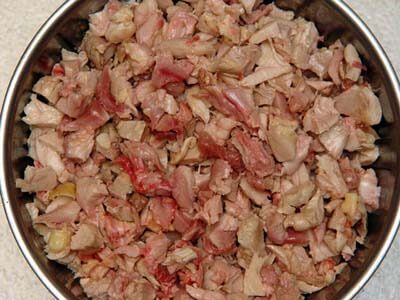
I would prefer it if the chunks were raw like the ones in the middle of this picture. Raw meat is harder to chew than cooked meat and will, hopefully, exert more cleaning action on the teeth. That said, nothing is as beneficial for dental health as daily brushing.
- Run the meaty bones, non-chunked meat, skin, liver, and eggs through the grinder using this plate with 4 mm holes:

Since I really hate chunking meat by hand, I tried the plates below which were a waste of money. Even the one with three large holes ground the meat too finely to allow for any dental health benefits.


- The ground meat/bones/skin/liver/eggs plus the fat drippings from the baking pan and the chunks of meat are then placed in the refrigerator while the supplements are mixed up.
Mixing up the supplement slurry:
- Whether you are using pre-ground rabbit with additional ground boneless poultry meat and skin, or chicken/turkey thighs that you have ground yourself, it is now time to combine the water, vitamin E, vitamin B-complex, taurine, iodized lite salt, and fish oil (if you have not already run the fish oil capsules through the grinder) with a whisk.
- Pour the supplement slurry into the meat/bones/skin/liver/egg mixture. Mix very well then portion into containers and freeze. Leave at least 3/4″ of head space to allow for expansion.
Ideally, the food should only be in the refrigerator (in a completely thawed state) for 48 – 72 hours so keep that in mind when choosing your container size. The average cat eats about 4-6 ounces (by weight not volume) per day. When I was first starting to feed a homemade diet, I used baby food jars so there would be no waste during the transition. I then quickly graduated to pint canning jars with reusable lids and rings. These jars hold 15 ounces of food. People with just one or two cats need to pick the container size that works for them.
Freezing the food in ice cube containers works well for nicely-sized portions. Store the food cubes in a ziplock bag.
You will note on Anne’s site that she prefers not to warm the food in the microwave. Instead, she heats it in hot tap water. This method would never work for me since it takes forever to get hot water at my sink and I hate wasting water. Plus both my cats and I are impatient so all of my cat food-warming is done in the microwave. Depending on the level of thawing, I may heat it for 5-10 seconds then stir. I repeat this several times so that the food is not cooked but is just warmed to ‘mouse body temperature.’
Exception to the above: I found that one of my cats, Toby, is very stubborn about eating meat if it is completely raw but I noticed that he would eat the accidentally-cooked pieces if I left it in the microwave too long. I have tried to cook it less and less over time but he is really stubborn about eating the completely raw rabbit so I humor him and feed it to him half cooked and half raw – or sometimes it is cooked even more than is shown in this picture.
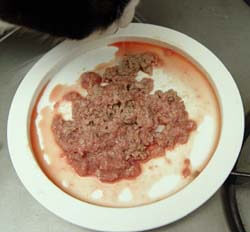
I do not worry about cooking the ground bones. I grind them so finely that this is not even a remote concern for me.
Canning the Food
There is a very helpful page on the Raw Meat Cat Food Company website. It provides information on canning cat food. My Robbie does not do well on any commercial canned food (he gets severe diarrhea) so this is a great alternative for me in an emergency situation so I don’t have to use commercial canned foods.
I purchased this pressure canner and now have homemade canned chicken, turkey, and rabbit cat food available for periodic feedings and for emergencies. This canned food also comes in handy if I have to be gone for 12 hours on a hot day. I leave this food out instead of the raw/semi-cooked diet. This canned food is also safe for human consumption so it doubles as an emergency supply for both two-legged and four-legged members of the house. Of course, this will not be an option for vegetarians.
Please note that I said for “periodic feedings.” I have no idea what nutrients and in what amounts are destroyed in the canning process so I would not want to feed this diet as a sole diet for more than a few weeks during an emergency situation.

Dental Health
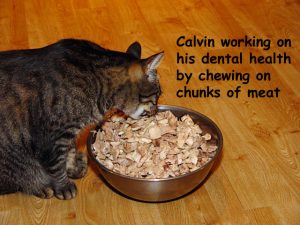
To readers who have navigated here from the side bar, this is a section that I quickly added to my Making Cat Food page. One of these days I will write a separate Dental Health webpage but, in the meantime, here are some comments on the subject which start off with a discussion about getting cats to chew on chunks of meat to help promote a healthy oral cavity.
~~~~~~~~~~~~~~~~~~~~~~~~~~~~~~~~~~~~~~~~~~~~~~~
Of course your cat has to have a healthy mouth to start off with when pushing the chewing-on-chunks-of-meat or tooth brushing issue. No cat will want to chew on any type of food or have his teeth brushed if he has a painful mouth!
If in doubt, please be sure to have your veterinarian examine your cat’s mouth. Poor dental health is the most commonly overlooked health problem in our cats and dogs!
Unfortunately, people (including myself….) do not take their cats in for dental cleanings/exams as often as they should. We need to stop over-vaccinating cats and pay more attention to their dental needs. (Please see my Vaccine page for more information on the rampant over-vaccination that occurs among our cats and dogs.)
I would encourage you to have your cat’s teeth properly cleaned and examined (under general anesthesia – *not* anesthesia-free) if you have not already done so. You want to know that your cat’s oral cavity is in a healthy state before you push the issue of chewing on chunks of meat and/or tooth brushing. If you start your cat off with clean teeth, you can then go forward and be proactive in keeping them clean.
It is important to note that chewing on meat and tooth brushing will not remove the plaque that is already on the teeth.
Only professional scaling under general anesthesia can do this in an effective and safe manner.
Unfortunately, like most cat and dog owners, I have been ignoring my cats’ dental health when using finely ground meat and bones and they are paying for it with unhealthy mouths.
Hopefully you will do better for your cat.
The reasons why my cats’ dental health is not being addressed are:
1) I am being lazy. De-boning and cutting up meat by hand is time-consuming.
2) My cats are also lazy (Robbie has a perpetual ‘Mommy, please cut my meat for me‘ look on his face….) and will often just eat around the chunks. Not only is this frustrating because the meat is wasted, it can also lead to an unbalanced diet.
If a large percentage of the meat in the diet is chunked….and the cat eats around the chunks….they will be eating too much ground bone/liver and supplements.
Therefore, watch your cat to make sure that he is consuming both the chunks and the ground-up portion. Otherwise, he will be eating an unbalanced diet.
And….if you have a kitten, train him to eat chunks of meat early in life!
One trick that you might try is to serve a full meal of 100% chunks – when your cat is ~12 – 18 hours hungry in order to get him used to chewing on meat chunks. Hunger goes a long way when trying to get a cat to embrace any new food but, again, make sure that your cat has a healthy, non-painful mouth.
As mentioned above, you can also try coating the chunks of meat in parmesan cheese or FortiFlora or crushed Temptations treats. My cats LOVE FortiFlora and would probably eat cardboard if I sprinkled it with FF. That said, some cats (~10-15%) do not like FF.
See Anne’s pictorial here where she shows the size of the meat chunks that her cats are chewing on. You may have to start smaller – like the size of a pea – just to get them used to the texture of meat. Unfortunately, most cats are not used to doing what nature intended for them and they may take some time to get used to gnawing on chunks of meat.
Another good dietary option to promote dental health for your cat is to feed them gizzards. Gizzards are very fibrous and tough to chew and If your cat will eat them alone, they can be used as a great dental snack.
If your cats like gizzards, you can incorporate them into the batch of food since they are easier to cut up when compared to muscle meat. Just count the gizzards’ weight as part of the 3 lbs of meat/bone/skin in the recipe above.
In order to promote dental health, many proponents of a raw diet use meaty bones. However, this is not within my comfort zone due to the risk of broken teeth, or swallowing sharp bone fragments. Plus, I don’t want raw bones drug around my house.
When first starting to feed a homemade diet, you may not want to do much chunking if your cat will not readily eat the chunks. First things first….ie….get them to embrace the finely ground up meat and bones diet first….then see if you can get them to chew on chunks of meat.
Brushing your cat’s teeth is the best way to keep his teeth clean if he will not chew on chunks of meat but, honestly, even if they do chew on meat? I would still suggest brushing their teeth as an added insurance policy. Please see this video that explains how to do this.
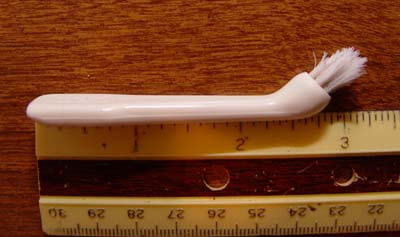
This toothbrush is the only product that is suitable for cats and is the one shown in the video.
Please pay close attention to the statement in the video regarding a thorough dental exam by your veterinarian before starting a brushing program.
Many cats have very painful mouths but show no outward signs of this pain. If you try to brush your cat’s teeth in the face of a painful mouth, all you will end up with is a cat that is scared – along with developing a strong aversion to toothbrushes. If this aversion occurs, you may never get him to accept tooth brushing once you have addressed the painful mouth with your vet.
In January, 2010, I started brushing Robbie’s teeth after a dental cleaning under anesthesia and am kicking myself for not doing it sooner. Robbie builds up tartar faster than any cat I have ever dealt with and he really could use dental cleanings 2 times per year. Plus, his breath smelled awful! It actually smelled worse than his feces.
July, 2011 update: Robbie’s teeth would have been a mess by now since his last dental was in December, 2009. However, since I have been brushing his teeth daily (or at least 6 times/week) for the past 18 months, his breath is still great and his teeth are very clean. I should have started doing this years ago!
Here is a video that I took in December, 2010. It is not a very good video but it shows that he tolerates it very well….and the kisses on the head are mandatory. :>)
February, 2012 update: It has been more than 2 years since Robbie’s last dental and his teeth are still very clean and his breath has no odor. I am still brushing his teeth every night.
November 2013 update: It has been 4 years since Robbie’s last dental cleaning under general anesthesia and I am happy to report that his breath is still great and his teeth look good but I can see some tartar build up. I rarely miss a day of brushing his teeth.
Understand that you will not be able to get to the inside of any teeth. I just focus the brushing on the outside surface of the upper and lower molars which is where the bulk of a cat’s teeth problems lie. At first, Robbie was not as cooperative with the lower molars as he was with the uppers but now he willingly lets me brush both areas. He is also very good about having his canine teeth (‘fangs’) brushed.
Note that you brushing back and forth like you would on your own teeth will annoy most cats. With Robbie, I swipe the tooth brush in one direction over and over again. Front to back, front to back, front to back….trying for ~8-10 swipes. Then the other side is back to front, back to front, back to front….
When first starting to train your cat, only swipe a couple of times then feed him a treat and let him go. Concentrate on the canine teeth and upper molars. Leave the lower molars until your cat has accepted the other areas.
It may take a month or more to get your cat used to this process.
Go slowly and be very patient!
Note that you do not have to use any toothpaste. A moistened (with water) toothbrush is all you need. In fact, I only use the CET toothpaste that I bought for Robbie as a treat after I brush his teeth. He likes the taste of it so I put a bit on my finger for him to lick off when we are done.
You can try using toothpaste but some cats start licking and chewing and that will make it hard to brush his teeth. You actually want the cat to keep their mouth closed and still.
One final comment….when I brush the upper molars, I pull up/back the lip/corner of the mouth so that I can actually see them. However, with the lower molars, I keep my finger under his chin so that he keeps his mouth closed. I then slip the bristles between his lips and just ‘feel’ the lower molars and listen for the sound of the bristles against the teeth but I don’t actually see them. Sometimes the same is true for the uppers.
It is easier to get the uppers brushed than the lowers.
When I find the time, I will write a Dental Health webpage which will address this issue in more detail.
Safety Issues
- Pre-ground supermarket meat: I hear you asking “But I don’t want to buy a grinder….so why can’t I just buy ground meat at the supermarket and add a calcium source?” I would never do this for reasons stated below. This method is definitely outside of my comfort zone and is not one that I can recommend.
I buy only whole meats from the market for the following reasons:
1) The surface of whole meats is where the bacteria resides – not in the depths of the meat. Therefore, cooking the thighs until there is at least a 20% surface cook will result in the destruction of the surface bacteria. I bake the thighs at 350 degrees until they are ~50% cooked.
There will be a loss of weight from the original 3 lbs of meat/skin/bones but by the time you add the drippings back in and add more than 1 cup of water to account for the moisture loss, you will be back at roughly 3 lbs.
I definitely suggest partial cooking of whole cuts of meat for any animal that may be immunocompromised due to illness, advanced age, or if they are receiving any immunosuppressive medications, or antacids.
Note: Boiling is one of the worst ways to cook meat in terms of nutrient loss. Baking is much better for nutrient retention. I used to boil the thighs because it was easier given the large batches that I make but I now bake them so that there is less nutrient loss and so I can save the fat drippings to put back into the food.
2) Once whole cuts of meat are ground, it needs to be cooked all the way. This is because the surface bacteria has been ground into the meat. Once the meat is ground, the surface area increases, which makes a great breeding ground for bacteria. This meat then sits in the refrigerated section of the meat department. It is not immediately frozen which would halt any further bacterial growth.
When packaging for the freezer, use a container size that will be used up with within 2 – 3 days of being in a completely thawed state in the refrigerator.
You may be wondering what the difference is between the ground meat at the supermarket and the ground rabbit that I buy from wholefoods4pets.com. Wholefoods4pets process the rabbits and then they immediately freeze the final product versus refrigerating it. It arrives on my doorstep frozen.
This meat comes to me in such a clean state so that it would probably be fine if left in the refrigerator for 4 days but I still package it in containers to be used up within 3 days of being completely thawed in the refrigerator.
3) I want to use fresh bone versus bone meal and it is very easy to grind the meat with the bones. With regard to adding a basic calcium source (like calcium carbonate) – instead of using bone – you run the risk of feeding an unbalanced diet because these calcium supplements are just that – calcium only. Bone is a source of more than just calcium.
- Source fresh meat: Check with the butcher who you are purchasing from and see what his delivery schedule is so that you may purchase the freshest meat possible. Sometimes I will ask my butcher if he has anything fresher in the back – versus what is in the display case.
However, having said this, one of the reasons why I started partially baking the poultry thighs is because I did not want to have to worry about shipment dates. I wanted the convenience of buying meat on my schedule – not my butcher’s.
- Safe food handling principles: Basic hygiene practices should be followed when preparing meat for yourself or your carnivore. My kitchen counters and cat feeding areas are kept very clean with a 1:22 bleach/water (1 part bleach to 22 parts water) solution.
- Bone size: Many people, including Anne, chunk a portion of the meat and then send the rest of the meat and bones through this coarse grinding plate.
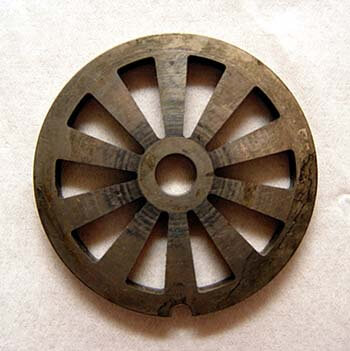
However, I am not comfortable with the size of bone pieces that result from the use of this plate. In fact, my cats have gotten bones the size shown below stuck in their mouths causing them great distress. I have a 4 minute video of my Robbie violently pawing at his mouth because of a bone fragment that had gotten stuck. He was not happy and neither was I!
I often get asked about acceptable bone size. This is where I differ from many raw feeders. I tend to err on the side of caution and grind the bones very finely.
This picture illustrates a bone size that I am not comfortable with.
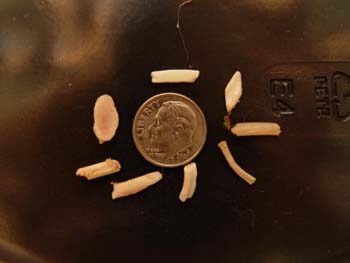
These bone pieces were taken from a single ground rabbit product obtained from wholefoods4pets.com. At my request, WF4P) offers an Extra Fine Double Ground product to appeal to my paranoia about bone size. (The regular double ground still yields the bone size as shown in the picture above.)
If you want to save money, order the single ground (this will yield the bone sizes shown above) and then it will be your choice to feed as is or send it through your grinder using a fine plate.
The Dangers of Commercial Pet Food – Especially Dry Food
With regard to the safety of raw meat diets, you will no doubt hear varying opinions on this issue. Many of my colleagues are adamantly opposed to the feeding of raw meat yet they think nothing of supporting the common practice of leaving bowls of dry food sitting out for pets to free-feed from which can be contaminated with fungal mycotoxins, bacteria, chemicals, or storage mites. It is very frustrating to witness this narrow-mindedness and lack of acknowledgement as it pertains to the contamination issues regarding dry food and treats – many of which have been recalled as noted below.
I would like to see my colleagues stop reflexively telling their clients that all raw meat diets are dangerous and understand that there are ways to source and prepare this diet that will actually make it safer than the commercial foods that they continue to recommend without any thought as to feline illnesses that these foods contribute to due to their species-inappropriate composition/ingredients, as well as the contamination issues.
I don’t think that a single cat or dog caregiver in the US is not aware of the thousands of cats and dogs that suffered tremendously and died – or have been left with failing kidneys and a shortened lifespan/diminished quality of life – due to the contamination of commercial foods processed by Menu Foods in the summer of 2007.
While the Menu Foods recall was the largest pet food recall in the history of commercial pet food, make no mistake in thinking that this was the first time that cats and dogs have died after consuming commercial pet foods that have been contaminated with chemicals, bacteria, and bacterial or mold toxins.
However, keep in mind that the vast majority of these contamination disasters (outside of the Menu Foods tragedy) have involved dry food or treats – not canned food. Therefore, if you decide that you don’t want to make your cat’s food, please feed canned food and keep the dry food out of your cat’s food bowl.
Dry food is simply not a very healthy or completely safe diet to be feeding to any cat.
See Urinary Tract Health and take a look at Opie’s pictures. If humans would stop feeding dry food to cats, cats like Opie would not have to suffer from excruciatingly painful – and life-threatening – urethral blockages.
There have been many instances of mold toxin-related deaths of pets after eating contaminated commercial dry food. I have listed a few below but these tragedies are too numerous to list all of them.
The regulatory body for the commercial pet food industry does allow a certain level of mold toxins (found in grains) to be present in your pets’ food. For me, this is unacceptable – especially when feeding cats – since grains have no business in their diet to begin with.
With regard to the extremely dangerous and life-threatening fungal toxins found in commercial dry food, this issue will never be a worry when feeding a grain-free diet – either in the form of canned food or the diet discussed on this page.
And if mold toxins and bacteria in dry food are not enough to cause us worry, please consider the fact that the fats contained in dry food become rancid over time – even with the preservatives that are added to the food. Heat, oxygen and light are all factors involved in fats becoming rancid. Keeping dry food in the refrigerator will help with the issue of heat but that still leaves the oxidation issue unaddressed.
Dry foods sit in warm warehouses and pet food stores before they even reach our pets’ bowls – promoting rancidity of fats, bacterial growth, mold growth, and toxin formation, and proliferation of storage mites.
At the very least, dry food should be kept in the refrigerator but it is better to just refrain from feeding this type of food.
See this link for an abstract that discusses the issue of storage mites that were found in 9 out of 10 bags of tested dry food.
There is absolutely no doubt in my mind that many cats and dogs have died as a result of consuming commercial pet foods yet the cause goes unrecognized.
These deaths include the various illnesses that manifest themselves due to the species-inappropriate composition (composition = percentage of calories coming from proteins/fats/carbohydrates and the water content) of the diet, as well as out-and-out contamination issues as discussed above and below in the Pet Food Recalls section.
Unfortunately, humans just don’t recognize these illogical and unsafe diets as the cause of the pet’s illness. Humans – including veterinarians – often fail to put 2 + 2 together in many instances of ill health or death. Food is often the last thing to even be considered as a cause or contributing factor in the event of an illness or death.
As stated above, we all must work within our comfort zone. If you find that you are not comfortable feeding a raw meat – or semi-cooked – diet even when implementing the tips in my safety section, then please feed canned food and remove all dry kibble from your cat’s diet.
Pet Food Recalls/Warnings
Throughout the history of the commercial pet food industry, there have been numerous recalls of dry kibble pet food and treats due to contamination issues involving bacteria (salmonella, etc.) fungal mycotoxins, deadly chemicals, and storage mites. And to be fair, there have also been recalls of commercial raw meat diets.
The list below by no means includes all reported contamination issues. If it did, this webpage would be a mile long.
For a list of current recalls, please see truthaboutpetfood.com. This website lists pet food recalls and is much more current than the information below. I cannot keep up with the task of posting all recalls/warnings/dry pet food-related animal deaths and human illnesses/deaths on this page.
~~~~~~~~~~~~~~~~~~~~~~~~~~~~~~~~~~~~~~~
January, 2011: 200 cows recently died after consuming feed contaminated with moldy sweet potatoes. The mycotoxins produced by the mold was the cause of death.
February/March 2010: Nature’s Variety raw chicken products – possible salmonella contamination. This company has recently implemented a pasteurization process to help ensure the safety of its future products.
January, 2010: Merrick Beef Filet Squares for dogs – FDA warning issued due to salmonella contamination of these treats.
October, 2009: Wysong recalls dry food with mold contamination.
October, 2009: Diamond Pet Food company recalls Premium Edge dry food due to thiamine deficiency which causes severe neurological damage and death in cats.
June 12, 2009: The U.S. Food and Drug Administration announced today it was suspending the temporary Emergency Permit issued to Evanger’s Dog & Cat Food Co., Inc. The deviations in their processes and documentation could result in under-processed pet foods, which can allow the survival and growth of Clostridium botulinum (C. botulinum), a bacterium that causes botulism in some animals as well as in humans.
January 9, 2009: Chicken jerky treats for dogs. Here is an excerpt from VIN (Veterinary Information Network):
The U.S. Food and Drug Administration has received 153 complaints during the past 16 months about illness in dogs that have eaten chicken jerky treats and continues to take reports “at a steady clip,” an agency spokeswoman said Friday.
November 25, 2008: Mars Petcare US extended its October 28, 2008 voluntary pet food recall of dry food that affected 15 states, adding more product carriers and brands affected by possible salmonella contamination.
October 28, 2008: Mars Petcare US is yet again recalling another salmonella-contaminated dry food manufactured at one of their facilities. This time it is Special Kitty Gourmet which is sold at Wal-Mart locations in 15 states.
October 20, 2008: Hartz Mountain Corporation is recalling rawhide chips due to salmonella contamination.
September, 12 2008: Mars Petcare US, once again, is recalling salmonella-contaminated dry pet food. This company makes many different brands of pet food. There were many human cases of salmonella infection possibly linked to this food.
August, 2008: The California Public Health department reported salmonella contamination of Pedigree dry dog food. Pedigree is made by Mars Petcare US.
August, 2007: The FDA recalled several dry foods under the Natural Balance Eatables product line due to botulism toxin contamination.
January 2006 – September 2007: See this link for a CDC report on a multi-state (19 states) outbreak of salmonella in humans during 2006 and 2007. The source was dry pet food made at Mars Petcare US.
December, 2005: Some of you may also remember the deaths of many cats and dogs after they ate Diamond pet food in 2005. These animals became very ill – and many died – secondary to liver failure from mold toxins (aflatoxin) that were contained in the grains of a commercial dry kibble. Many cats and dogs died as a result of this contaminated food. The surviving animals will have permanent liver damage.
Dogs
I frequently receive emails from readers asking for recommendations for websites like mine that discuss optimal canine nutrition. There may be some out there but I don’t know of any specific ones to send readers to.
That said, I recommend purchasing Feeding Miss Lilly – a easy-to-read, common-sense-based book written by my colleague, Dr. Christine King.
I will say that if I had a dog, she would be fed the same diet that my cats are fed. However, if someone wants to incorporate some vegetables and grains into their dog’s diet, appropriate balanced recipes can be formulated. Please refer to Dr. King’s book linked above.
Dogs differ from cats in that they are not true obligate carnivores. Therefore, they can utilize plant proteins in a more efficient manner when compared to cats. Dogs also have a higher thirst drive to make up for the water deficit in dry kibble.
But, all that said, I would still feed my (hypothetical) dog a fresh, water-rich, minimally cooked, meat-based diet and refrain from feeding her a water-depleted, cooked-to-death, high carbohydrate, plant-based protein, and often highly-contaminated dry food.
Conclusion
If you would like more information regarding the obligate carnivore status of the cat, please see Feeding Your Cat: Know the Basics of Feline Nutrition. If you would like to read a more in-depth discussion of this topic, please see Dr. Zoran’s wonderful paper entitled The Carnivore Connection to Nutrition in Cats.
As stated above, if you decide that you are not comfortable preparing your own cat food, please feed canned food and get the dry food out of your cat’s food bowl.
Partially updated: January 2019
Partially updated 1/7/25
Lisa A. Pierson, DVM